
AI Answering Service vs Human Answering Service: Cost, Coverage and Call Quality
An AI answering service uses voice AI to answer inbound calls, understand the caller’s request, and finish routine tasks such as bookings and record updates during the call, at any hour. A human answering service uses live operators who take messages and handle judgment calls. AI usually wins on coverage and cost per call; people still lead on sensitive conversations.
7:48 PM. A customer calls a diagnostics chain to move tomorrow’s blood test. The front desk closed at seven, so the call rolls over to an outsourced answering service. 7:53 PM. After a wait, an operator takes a message: name, number, “wants to reschedule.” 9:20 AM the next day. The message reaches the clinic team, who call back twice and get voicemail. 11:00 AM. The customer has already booked the test somewhere else.
Nobody in that chain did anything wrong. The answering service captured the call; it was never set up to finish it. That is the real question behind AI answering services vs. human answering services: which option resolves more calls, at what cost, and with what quality when the caller is upset or the request is unusual. Below, you will find what an AI answering service is, a side-by-side comparison, how cost, coverage, and call quality really compare, which calls belong with AI or with people, the rules that apply in India, and a 30-day switching plan.
What Is an AI Answering Service?
An AI answering service (also called an AI phone answering service, an AI receptionist, a virtual answering service, or an automated answering service) is software that answers a business’s inbound calls and holds a natural conversation with the caller. It listens, determines intent, answers questions, and acts in connected systems: it books appointments, checks orders, logs leads, or routes calls to the right person with a summary.
That last part separates AI call answering from two older options. A legacy IVR makes callers press keys through a fixed menu, which is why so many enterprises are retiring them. A traditional human answering service uses shared operators who follow a script and pass messages along. Voice AI for inbound calls sits between the two: conversational like a person, connected like software, and available at any hour.
How AI Call Answering Works on a Live Call
- Answer: The AI picks up on the first ring, with no queue, even when many people call at once.
- Understand: Speech recognition and language models work out what the caller wants, including mid-sentence changes and interruptions.
- Act: It checks the calendar, CRM, or order system and completes the task while the caller listens.
- Hand off: If the request needs a person, it transfers the call with the transcript and context so the caller doesn’t repeat the story.
- Record: The outcome, summary, and next step are written back to the business’s systems.
Organizations that started with AI receptionist agents for front-desk calls often extend the same setup to after-hours lines, overflow, and customer support.
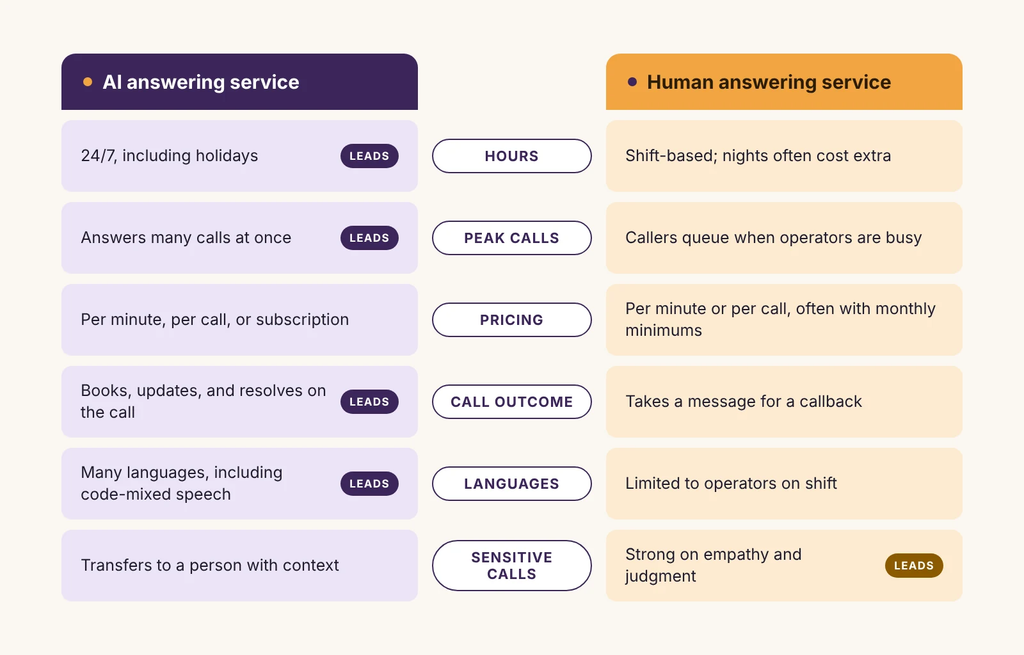
AI Answering Service vs Human Answering Service at a Glance
Cost: What You Actually Pay per Resolved Call
Price sheets make the two options look easy to compare. Human answering services usually bill per minute or per call, often with monthly minimums and higher rates for nights, weekends, and holidays. An AI answering service charges per minute, per call, or as a subscription. Neither price sheet shows the cost that matters most: what it takes to resolve a call.
A message is not a resolution. When an operator takes a message, your own team still has to call back, often more than once, and some callers will have moved on by then. Those callbacks are labor you pay for twice. Comparing the two options fairly means using one formula for both:
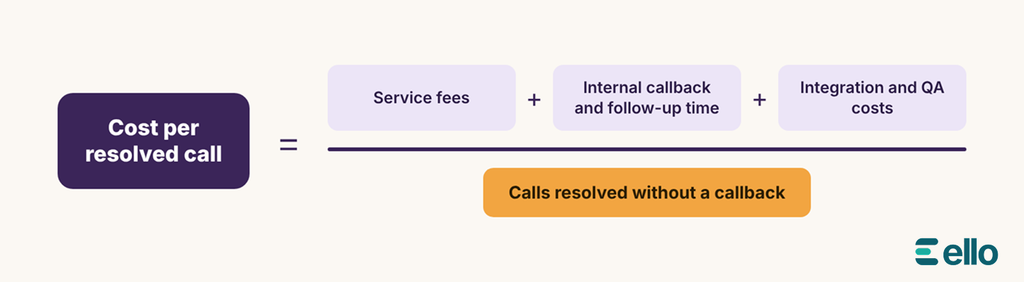
Watch for these hidden costs on each side:
- Human answering service: after-hours surcharges, overflow minimums, script updates, and the internal time spent working through message queues the next morning.
- AI answering service: integration work with calendars and CRMs, conversation design, ongoing tuning, and the human team that takes escalated calls.
- Both: quality reviews, compliance checks, and reporting.
Once routine calls finish on the line, handle time and repeat contacts fall as well, which is how contact center automation reduces handle time and the cost of each call.
Coverage: Hours, Peaks, and Languages
Coverage is more than being open 24 hours. A real 24/7 answering service has to hold up in three situations.
- After hours: As an after-hours answering service, AI handles a call at 2 AM the same way it handles one at 2 PM. A human service can staff nights too, but usually at a higher rate and with fewer operators on shift.
- Peaks: A billing error, a festive sale, or a service outage can push hundreds of calls into the same hour. Operators answer one call at a time, so callers queue or abandon. An AI answering service handles many conversations at once.
- Languages: In India, one inbound line can receive calls in Hindi, Tamil, Telugu, Marathi, Bengali, and English in a single hour, often mixed in one sentence. Human services cover the languages of the operators on shift; multilingual voice AI in India follows the caller’s language, including code-mixed speech.
Call Quality: How to Measure It Fairly
Call quality is where most comparisons turn into opinion. Measure an AI answering service and a human service with the same scorecard, on the same call types, over the same weeks.
Call Center KPIs to Compare AI and Human Answering
| Call center KPI | What it tells you | How to measure it fairly |
|---|---|---|
| Answer rate | Share of calls picked up | Include nights, weekends, and peak hours |
| Average speed of answer (ASA) | How long callers wait | Measure from first ring to first word |
| First call resolution (FCR) | Calls finished without a callback | Count bookings and updates completed on the call |
| Escalation rate | Calls handed to a person | Check whether the handoff carried context |
| Accuracy | Correct details captured | Audit a sample of transcripts or messages |
| Customer satisfaction (CSAT) | How callers felt | Use the same post-call survey for both |
Response time affects quality more than many buyers expect. A pause of a second or two makes a voice agent sound broken, which is why AI voice agent latency belongs on the scorecard next to accuracy.
People still lead on empathy and judgment. In a Gartner poll published in June 2025, 95% of customer service leaders said they plan to keep human agents, and Gartner expects half of the organizations that planned major workforce cuts because of AI to drop those plans by 2027.
Which Calls Should Go to AI and Which to People?
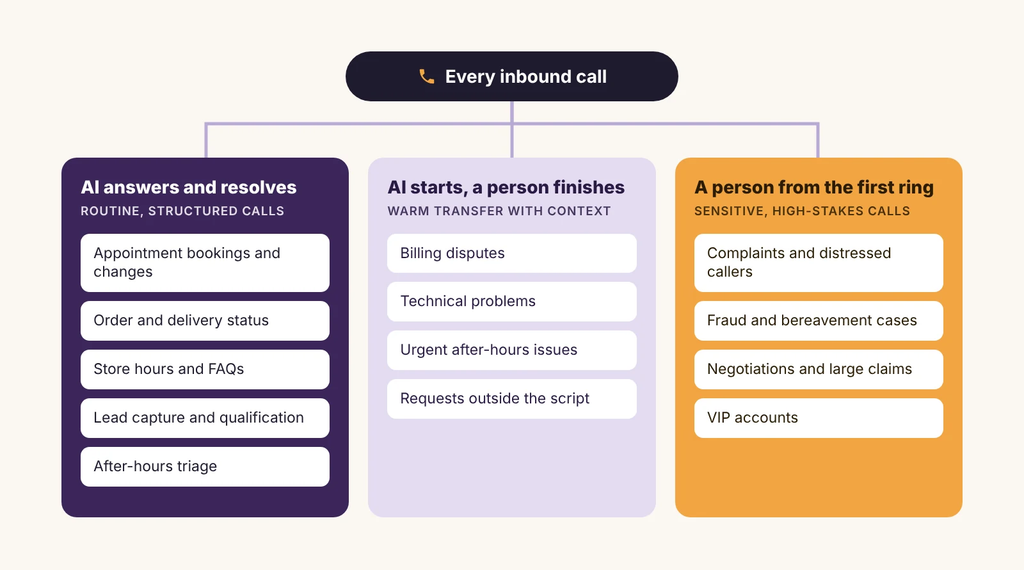
The strongest setup is rarely all AI or all human. It is a routing design. The AI answering service picks up every call, resolves what it can, and hands the rest to people who now have time for them. Booking calls usually move first: AI booking agents confirm, reschedule, and cancel appointments without a callback.
When a Human Answering Service Still Makes Sense
- Emotional calls: bereavement, medical worries, fraud victims, and complaints where callers need to feel heard.
- High-stakes decisions: negotiations, large claims, legal matters, and VIP accounts.
- Very low volume: a business with a few calls a week may only need a virtual receptionist, without the integration work AI requires.
For everything in between, AI warm transfers give the human agent the transcript, the caller’s intent, and account details before they say hello. Deciding where to draw the line is central to any AI phone agent vs. human agent plan.
AI Answering Service in India: Languages, DPDP, and Call Recordings
- Code-mixed calls: Callers switch between English and Hindi or a regional language mid-sentence. Test any AI answering service with real recordings from your own lines, not a scripted demo.
- Recordings are personal data: Under India’s DPDP Rules, notified in November 2025 and phased in through 2027, call recordings and transcripts that identify a caller are personal data. Tell callers that the call is recorded and why.
- Accountability stays with you: The business remains the data fiduciary, and the answering service, human or AI, usually acts as a data processor. A clear map of voice AI compliance in India helps set retention, access, and deletion rules before launch.
- Security evidence: Ask any provider for a SOC 2 Type II report and details of how call data is encrypted.
How to Switch to an AI Answering Service: A 30-Day Pilot
AI answering service best practices start small and measure everything. A 30-day pilot keeps the risk low.
- Before launch, pick the lines: Start with your after-hours answering service lines or one high-volume call type, such as bookings or order status.
- Before launch, set the baseline: Record answer rate, ASA, FCR, escalation rate, and CSAT for the current human service.
- Week 1, design the calls: Write the main conversation paths, the questions the AI must never answer, and the exact escalation rules.
- Week 1, connect the systems: Link the calendar, CRM, and ticketing tools the AI must update during calls.
- Weeks 2 to 3, run in parallel: Route part of the traffic to the AI answering service and keep the human service as backup.
- Week 4, compare and decide: Use the KPI table above and cost per resolved call, then expand, adjust, or stop.
Where Inbound Call Answering Is Heading: Hybrid by Design
- AI answers first, people finish the hard calls: Gartner’s March 2025 forecast expects agentic AI to resolve 80% of common customer service issues without human help by 2029, with a 30% cut in operating costs.
- No fully agentless service: Gartner also predicts that by 2028 none of the Fortune 500 will have fully removed human customer service, according to its September 2025 prediction on agentless service.
- Answering becomes resolving: An AI answering service will be judged on calls resolved, not calls answered, the same way AI customer service in 2026 is judged on outcomes.
For staff, the change is about which calls they take. The debate over whether AI will replace call center agents has a practical answer on inbound lines: people spend less time on bookings and status checks and more on the calls where judgment matters.
The Ello Advantage: Inbound Calls Answered and Resolved
Ello is an enterprise-grade AI voice agent platform that answers inbound calls and finishes the job on the line. It books, updates, and resolves routine calls at any hour, and hands sensitive calls to your team with full context.
- Adaptive Prompting Engine: dynamic, non-scripted dialogue, handles interruptions, reads sentiment and urgency in real time.
- Voice-to-Action Engine: completes tasks in CRMs, ERPs, ATS, and PMS platforms while the caller is still on the line, through 40+ integrations including Salesforce, HubSpot, Slack, and Zapier.
- Multilingual Vernacular Native: native support for 100+ languages with accent adaptation, including code-switching common on Indian calls.
- Self-Evolving Architecture: studies call outcomes and rewrites its own prompts, with guardrails, compliance checks, and audit trails on every change.
- Multi-Agent Quality Control: specialized AI agents audit and improve each other’s performance.
- Speed and Reliability: sub-500ms response latency and a 99.99% uptime SLA; powers 50,000+ calls daily.
- Enterprise Security Standards: SOC 2 Type II attested, with encryption and hallucination guardrails.
After-hours lines and booking calls are common first deployments, much like conversational AI in healthcare programs that begin with appointment and reminder calls.
Hear how Ello answers calls in English, Hindi, or a regional language: Schedule a demo with Ello.
Frequently Asked Questions
1) What is the difference between an AI answering service and an AI receptionist?
The terms overlap. An AI answering service usually covers all inbound calls, including after-hours and overflow. In contrast, an AI receptionist or virtual receptionist usually means front-desk tasks such as greeting, routing, and booking appointments. Enterprise platforms do both on the same voice AI.
2) How much does an AI answering service cost compared with a human answering service?
Both bill per minute, per call, or by subscription, so headline prices can look similar. The fair comparison is cost per resolved call, including your team’s callbacks. An AI phone answering service usually costs less per resolved call because it finishes routine tasks during the call instead of taking messages.
3) Can an AI answering service handle Hindi and regional languages?
Yes, if the platform supports them natively. Look for coverage of the languages your callers use and for code-switching, where callers mix English with Hindi or a regional language in one sentence. Test with real call recordings before you sign.
4) Is an AI answering service allowed under India’s DPDP rules?
Yes. The DPDP Rules regulate how personal data is handled, not AI itself. The business stays accountable as the data fiduciary, so tell callers about recording, set retention limits, and confirm the provider’s security evidence, such as a SOC 2 Type II report.
5) When should a business keep a human answering service instead of an AI answering service?
Keep people for emotional, high-stakes, or unusual calls, such as complaints, fraud cases, and negotiations, and for very low call volumes. Most businesses get the best results from a hybrid: AI answers every call and resolves routine requests, then transfers the rest with context.
Conclusion
The choice is not really AI or people. It is which calls each one should own. An AI answering service gives you round-the-clock coverage, capacity during peaks, and calls that end with the task done, while human agents keep the conversations that need empathy and judgment.
Start with one line, measure cost per resolved call and the KPIs above against your current service, and expand where the numbers hold. The businesses that design their answering this way stop paying twice for every call.