
AI Customer Service in 2026: What It Actually Looks Like Inside the Contact Center
High contact center handle times, rising staffing overhead, and fragmented ticket routing continue to strain operational margins across enterprise service organizations. Industry benchmarks show live agent phone interactions average $6.00 to $12.00 per contact, while traditional self-service options routinely fail when faced with complex customer requests. Rigid interactive voice response (IVR) phone trees and rule-based chatbots force frustrated callers to wait for human agent escalation, driving up cost-per-contact metrics while degrading customer satisfaction scores. AI customer service addresses these bottlenecks by replacing deterministic decision trees with cognitive workflows and reducing average handle time through contact center automation.
Solving this friction requires a fundamental shift in how organizations execute customer support. The enterprise landscape is moving past static text bots toward autonomous digital teammates. At the center of this transformation is real-time voice interaction, enabling AI in customer service to resolve most routine and many complex inquiries over the phone while bringing in human specialists when needed. Understanding what a voice AI agent is helps organizations evaluate how AI-driven support streamlines frontline service operations.
What Is AI Customer Service?
AI customer service uses language models, speech recognition, and automated workflows to answer, resolve, and route customer requests across voice, chat, and email. Unlike rule-based IVRs and chatbots, it understands open-ended requests, acts in backend systems, and hands complex cases to human agents with context.
The Structural Limits of Legacy Support Automation
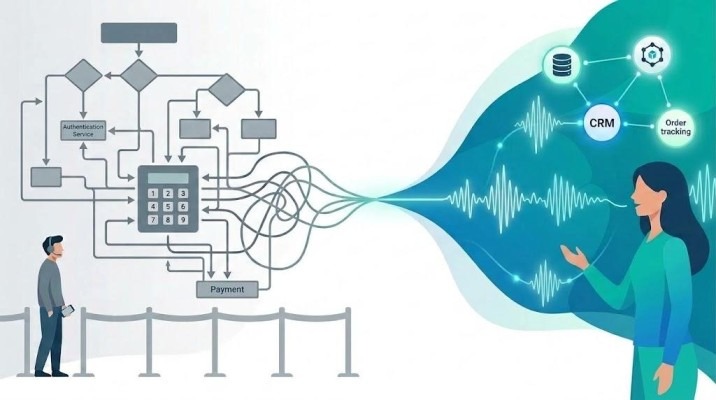
For over a decade, automated support systems relied on deterministic branching logic. Traditional text chatbots matched basic intent triggers and worked for simple tasks like checking an account balance or checking an order status. However, when transactional inquiries required dynamic reasoning, context switching, or multi-system database updates, rule-based systems collapsed.
Legacy voice infrastructure suffered even greater limitations. Traditional voice menus forced customers through repetitive, pre-programmed options, only to land them in a queue and repeat their issue to a human agent. Enterprise leaders are replacing these static menus with AI customer support to overcome these structural constraints. By moving from legacy IVR systems to voice AI frameworks or deploying conversational IVR, organizations can gain operational efficiency with systems that support fluid, multi-turn conversations and immediate task execution.
Here is how the three generations of support automation compare:
| Capability | Legacy IVR | Rule-based chatbot | Agentic voice AI |
|---|---|---|---|
| Understanding | Keypad inputs or fixed keywords | Predefined intent triggers | Open-ended natural speech, including interruptions and topic changes |
| Actions | Routes calls to queues or extensions | Answers FAQs, with limited backend lookups | Authenticates callers and updates CRMs, tickets, and payments live on the call |
| Handoff | Caller repeats the issue to an agent | Escalates with a transcript, often without context | Warm transfer with verified ID, transcript and summary |
| Latency | Long menu prompts and hold queues | Instant text replies, but no voice | Spoken responses in under 500 milliseconds |
| Languages | A separate menu for each language | Usually a limited set of languages | Multiple languages, including mid-sentence code-switching |
Deconstructing Real-Time Voice AI for Enterprise Support
Modern voice platforms use an architecture that processes speech, applies policy rules, and executes operational workflows in real time. Unlike legacy text bots wrapped in a basic text-to-speech engine, an agentic voice AI framework handles the unpredictable nature of human speech, including interruptions, sudden context shifts, and background noise.
Low-Latency Conversational Processing
Human conversation relies on near-instant turn-taking, with pauses between speakers that typically last only a fraction of a second. Early voice software introduced multi-second latencies between a caller finishing a sentence and the machine responding, creating an awkward experience. Understanding and managing voice AI latency is critical for fluid interaction. Current enterprise voice architectures stream audio via WebSockets directly into speech recognition and language models to keep response times low; Ello’s platform, for example, responds in under 500 milliseconds for natural dialogue.
Dynamic Context Management and Non-Linear Dialogue
Customers rarely state their issues in neat, structured sentences. A caller reporting a damaged shipment might interrupt the system mid-verification to change their delivery address or ask about a refund policy. Advanced voice AI systems track state across multi-turn interactions, keeping context variables in memory while dynamically updating conversation branches.
Real-Time Voice-to-Action Execution
Answering a question is only half the challenge; resolving an issue requires immediate backend action. Customer service AI platforms don’t just read script responses. Instead, they trigger backend functions during the call: authenticate users, update records in enterprise platforms, update support tickets, and process payments securely, all while staying live on the phone.
Walkthrough: What It Actually Looks Like Inside the Contact Center
To see how real-time AI customer service functions in production, consider this live airline support scenario:
- Caller Contact & Intent: A customer calls: “Hi, my flight tomorrow morning was delayed, and I need to rebook to an afternoon flight, but I also need to change my seat preference.”
- Real-Time Authentication & Interruption: The voice agent authenticates the caller against the CRM, retrieves the itinerary, and starts presenting available afternoon flights. The caller interrupts mid-sentence: “Wait, actually, can you check if there is anything leaving tonight instead?”
- Context Switching & System Execution: The platform halts speech generation immediately, updates its search parameters without losing caller context, retrieves evening availability, confirms selection, updates the reservation via API, and emails the updated boarding pass.
- Context-Aware Escalation: If the customer requests an off-policy refund or fee waiver, the AI agent packages the verified caller ID, transcript summary, and context, handing off the live call to a specialist with zero repetition.
Architectural Pillars of Enterprise Support Automation
Building a scalable framework for enterprise AI customer service requires unifying voice interactions with back-office data pipelines and ticketing systems.
- Multi-Agent Orchestration: Rather than relying on a single monolithic model to process every inquiry, enterprise deployments use dedicated micro-agents across specialized operational domains, effectively eliminating manual call workflows. A primary triage agent evaluates caller intent and hands off execution to sub-agents optimized for specific tasks, such as billing adjustments, technical troubleshooting, or account recovery.
- Autonomous Support Ticket Automation: Manual data entry remains a major driver of post-call agent fatigue and administrative overhead. Deploying AI agents in call centers ensures every AI-handled interaction generates structured call summaries, tag categories, sentiment metrics, and resolution logs directly in platforms like Zendesk or Salesforce.
- Vernacular Code-Switching and Accent Adaptation: Modern voice architectures handle colloquial phrasing, dialect variations, and mid-sentence language transitions without requiring explicit menu selections. Adopting multilingual voice AI strategies lets global enterprises deploy AI customer support that serves diverse user bases.
Overcoming Security, Guardrails, and Hallucination Risks
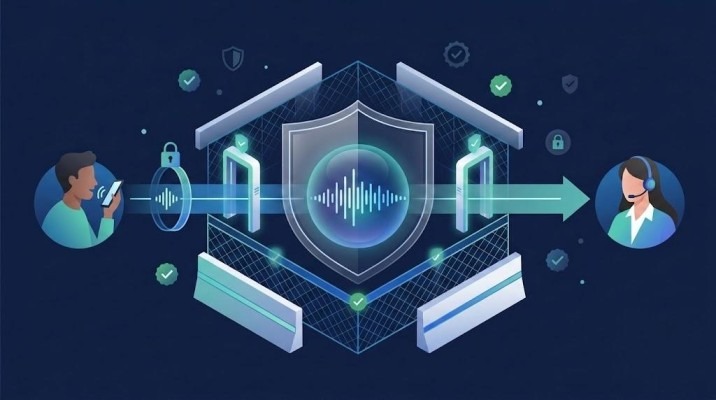
Deploying autonomous voice interactions in production environments requires strict operational security controls and regulatory compliance enforcement.
- Hallucination Containment: Voice models operate within defined knowledge spaces, pulling responses strictly from verified policy documents and API payloads. Guardrails keep responses strictly within verified sources; if a query falls outside permitted guidelines, the system gracefully transfers the call to a human specialist with full context.
- Deterministic Guardrails: Hard-coded security rules sit atop probabilistic language models in voice AI architectures, enforcing identity verification, refund limits, and required regulatory disclosures by rule rather than model judgment.
- Data Privacy and Regulatory Compliance: Voice pipelines support compliance standards including SOC 2, PCI DSS payment security, HIPAA, GDPR, TCPA, and regional telephony mandates (such as local calling windows and TRAI guidelines). Audio streaming data is encrypted in transit and at rest, with configurable retention controls to protect sensitive call logs.
The Ello Advantage: AI Customer Service Built for the Enterprise
While general enterprise software streamlines basic ticket workflows, an AI voice agent platform needs specialized infrastructure to automate complex contact center operations fully.
Designed explicitly for high-volume enterprise environments, Ello moves past static scripts to deliver AI customer service across operations, sales, and customer care:
- Self-Evolving Architecture: Ello features an adaptive learning loop that continuously analyzes live conversational telemetry and post-call resolution rates. The system refines its prompting parameters within approved corporate boundaries and with full audit logging, driving measurable gains in operational efficiency and resolution rates without manual developer refactoring.
- Adaptive Prompting & Voice-to-Action Engine: Ello’s native reasoning engine powers responsive conversations by dynamically adapting to real-time caller emotion, urgency, and sudden speech interruptions. The platform authenticates callers and executes transactional tasks directly in CRMs, ERPs, and ticketing tools while keeping the conversation natural on the line.
- Multilingual Vernacular Native: Ello natively supports 30 languages and hundreds of regional accents. It handles fluid, mid-sentence code-switching and local colloquialisms, ensuring high resolution rates across diverse global markets.
- Enterprise Security Standards: Built with enterprise-grade guardrails, Ello keeps every customer conversation secure. It is SOC 2 Type II certified, enforces end-to-end data encryption, maintains strict hallucination containment policies, and provides built-in controls to support adherence to localized telecommunication mandates.
Frequently Asked Questions
1) How does voice AI in customer service differ from traditional speech recognition IVR systems?
Traditional speech recognition IVRs use keyword matching to navigate pre-programmed menu trees. AI customer service platforms use real-time natural language reasoning to understand conversational intent, handle non-linear dialogue interruptions, and execute downstream enterprise API tasks directly during the call.
2) Can AI customer service handle complex, multi-step user inquiries?
Yes. Enterprise AI systems use multi-agent cognitive orchestration to break complex requests into sub-tasks. The system authenticates users, queries backend databases, executes policy rules, and updates records across enterprise platforms in a single, continuous interaction.
3) How do autonomous voice systems handle caller interruptions or sudden changes in context?
Advanced voice architectures maintain dynamic state tracking while operating low-latency streaming pipelines. If a caller interrupts mid-sentence or changes the topic, the engine halts current speech generation, updates its internal context variables, and responds naturally to the new query.
4) What happens when an automated customer service agent cannot resolve an issue?
If an inquiry falls outside predefined operational boundaries or requires human authorization, the platform executes a context-aware handoff. It routes the call to a live agent with a real-time transcript, sentiment score, and summary of steps taken, reducing repetition for callers.
5) How do enterprise platforms maintain compliance and security in AI customer service?
Enterprise platforms incorporate deterministic guardrails, encrypted data transmission, configurable retention windows, and PCI DSS compliance for payments. They enforce strict identity verification checks before sharing sensitive account information.
6) What are examples of AI in customer service?
Common examples include voice agents that answer and resolve routine calls, chatbots that handle order tracking and returns, automatic ticket tagging and call summaries, real-time agent assist that suggests answers during live calls, and multilingual support that switches languages mid-conversation.
7) Will AI replace customer service agents?
No. AI handles high-volume, repetitive requests such as balance checks, rebookings, and order updates, while human agents focus on complex, sensitive or high-value conversations. In most contact centers, AI absorbs the routine volume and hands harder cases to people with full context, so agents spend less time on repetitive work.
8) How much does AI customer service cost?
Costs depend on call volume, call length, integrations, and the vendor’s pricing model, which is usually per minute, per call, or per resolution. As a reference point, live agent phone interactions average $6.00 to $12.00 per contact, so automating routine calls typically lowers the overall cost per contact significantly.
9) How do you measure the success of AI in customer service?
Track containment rate (the share of calls resolved without a human), average handle time (AHT), customer satisfaction (CSAT), first-contact resolution, and transfer rate. Comparing these metrics before and after deployment shows whether the AI is genuinely resolving issues or simply deflecting them.
Conclusion
The shift from reactive deflection to fully autonomous voice interaction represents the next major evolution in enterprise customer care. Legacy IVRs and basic text chatbots exposed the limits of rigid decision trees, creating operational bottlenecks and driving up cost-per-contact metrics. By combining low-latency speech processing, dynamic reasoning, and real-time backend API execution, AI customer service lets enterprises resolve complex inquiries over the phone while keeping human handoffs smooth when needed.
Organizations that modernize their contact center infrastructure with self-evolving voice architectures can reduce handling delays, scale operational capacity, and deliver immediate resolution at lower overall overhead. To discover how autonomous voice agents can elevate your enterprise contact center capabilities, explore Ello’s enterprise voice platform.