
AI Voice Agent Latency Explained: Why Response Time Makes or Breaks the Call
A voice conversation depends on timing. Even a short pause after a customer finishes speaking can make an AI agent feel slow, uncertain, or disconnected.
That makes AI voice agent latency a critical part of the customer experience. It affects how naturally an agent responds, handles interruptions, retrieves information, and keeps a conversation moving.
For enterprises, even small delays can affect thousands of daily interactions. Understanding where latency comes from and how to measure it is essential for delivering reliable voice AI at scale.
What AI Voice Agent Latency Actually Means
AI voice agent latency refers to the time between a customer finishing their speech and hearing the AI begin its response.
That gap can involve several stages:
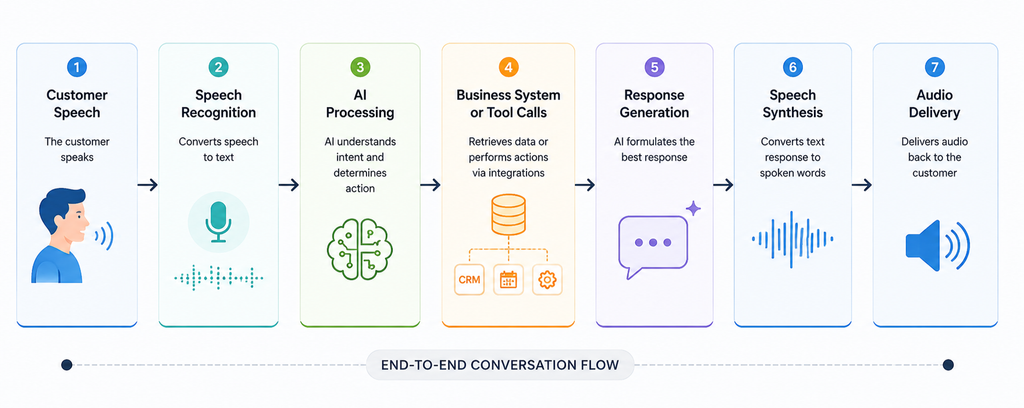
Each stage can add delay. Speech-to-text needs to process what the customer said. The AI needs to interpret the request and determine what to do. If the request requires information from a CRM, payment system, scheduling platform, or other backend application, that interaction adds another layer. The response then needs to be converted into speech and delivered back to the caller.
This means the most important factor is the end-to-end experience the customer hears, not the processing time of any single component.
Why Latency Changes the Conversation
When the response arrives quickly, the interaction feels continuous. When the pause becomes noticeable, customers may repeat themselves, interrupt the agent, or assume something went wrong.
NVIDIA recommends targeting under one second between the end of a customer’s speech and the first synthesized audio for a conversational voice agent to feel responsive. Its 2026 guidance notes that delays above one second can begin to interrupt the natural flow of conversation.
That makes response time in voice AI a practical customer experience consideration, not simply an engineering benchmark. A slower response can create a chain reaction:
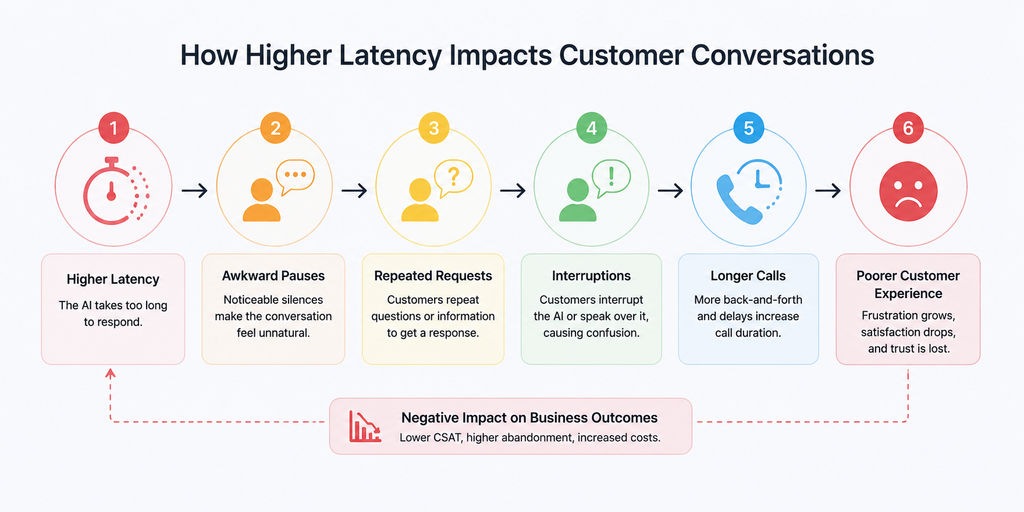
Latency also affects how well an agent handles interruptions. If a customer starts speaking while the AI is responding, the system needs to detect the interruption and stop speaking quickly. Otherwise, even an accurate response can feel disconnected from the conversation.
The goal, therefore, is not simply to make an AI voice agent respond faster. It is to create real-time voice AI performance that keeps turn-taking natural, responses timely, and the conversation moving.
The Fastest First Response Can Still Feel Slow
A voice agent can respond quickly to a simple question and still create noticeable delays when it needs to complete a business action.
Consider a customer asking, “Where is my order?”
The AI may recognize the request immediately. But it still needs to identify the customer, retrieve the order from the relevant system, check the latest status, and formulate a response.
The customer experiences all of that as part of one conversation.
The same applies when a voice agent needs to:
- Schedule or reschedule an appointment
- Retrieve account information
- Update a customer record
- Verify an identity
- Process a service request
- Check payment or order status
This is why real-time voice AI performance depends on the entire technology stack. A fast speech model cannot compensate for a slow backend workflow.
Enterprises should therefore evaluate latency across the complete customer journey rather than looking only at model or platform benchmarks.
How Enterprises Should Measure Real-Time Voice AI Performance
Asking a provider, “What is your latency?” doesn’t provide enough information.
Enterprises should understand how that number was measured.
A meaningful evaluation should consider:
- End-to-end latency: Measure the time the customer actually experiences, including network and telephony factors.
- p50 latency: Shows the typical interaction.
- p95 and p99 latency: Reveal how the system performs during slower interactions. An attractive average can hide delays that customers encounter regularly.
- Geography: Network distance and telephony routing can affect response times.
- Concurrency: A system that performs well during a small test may behave differently under production call volumes.
- Tool calls: Test the agent while it accesses real CRM, scheduling, payment, or other enterprise systems.
- Language: Measure performance across the languages and accents the target customer base actually uses.
The evaluation should happen under conditions that resemble production. A laboratory benchmark provides useful information, but it doesn’t tell the whole story.
How Enterprises Can Reduce Voice AI Latency
Improving AI voice agent latency requires attention to the full interaction, not a single component.
- Optimize the architecture
Streaming speech recognition, incremental response generation, and parallel processing can reduce unnecessary waiting between stages.
- Reduce backend delays
If every customer request requires a slow API call, the voice experience will inherit that delay. Design critical enterprise workflows for fast retrieval and execution.
- Improve interruption handling
The agent should recognize when a customer starts speaking and stop its response quickly. This keeps turn-taking natural and prevents customers from talking over the system.
- Use concise responses
A voice agent doesn’t need to deliver a long explanation when a short answer completes the task. Concise responses reduce interaction time and keep conversations focused.
- Monitor the complete call
Teams should track response latency alongside task completion, transfer rates, call duration, and customer satisfaction. This provides a clearer picture of whether faster responses are actually improving the customer experience.
How Ello Supports Real-Time Voice Experiences
For enterprise voice AI, responsiveness depends on more than the conversational model’s speed. Customer interactions also involve business systems, workflows, data retrieval, multilingual communication, and human handoffs.
Ello brings these elements together through AI voice agents designed for real-time customer interactions. The platform can understand customer intent, work with enterprise systems, automate workflows, and transfer conversations to human agents when additional expertise is required.
This approach helps organizations evaluate AI voice agent latency as part of the complete customer interaction rather than as an isolated technical benchmark. Faster responses, connected workflows, and contextual conversations work together to create voice experiences that feel more natural and responsive.
Conclusion
AI voice agent latency directly influences how customers experience a conversation.
A technically capable voice agent can still frustrate customers when responses arrive too slowly, interruptions take too long to register, or backend workflows create unexplained pauses. Enterprises therefore need to evaluate response time across the complete call journey, under realistic production conditions.
The right benchmark isn’t simply the lowest latency number. It is consistent, responsive performance that helps customers complete tasks without awkward pauses, repeated requests, or unnecessary transfers.
For businesses deploying voice AI at scale, treat real-time voice AI performance as a core customer experience metric, alongside accuracy, task completion, reliability, and service quality.
FAQs
1. What is AI voice agent latency?
AI voice agent latency is the time between a customer finishing their speech and hearing the AI respond. It can include speech recognition, AI processing, backend calls, and speech generation.
2. What is a good response time for voice AI?
There is no single ideal number. Enterprises should evaluate end-to-end latency, including p50, p95, and p99 performance.
3. Why does latency matter for voice AI?
High latency creates awkward pauses, repeated requests, interruptions, and longer calls, which can affect the overall customer experience.
4. How can enterprises improve AI voice agent latency?
Enterprises can reduce latency by optimizing the AI architecture, backend integrations, API calls, streaming, and interruption handling.
5. How should businesses evaluate voice AI latency?
Test real customer scenarios across target geographies, languages, integrations, and call volumes, while measuring end-to-end p50, p95, and p99 latency.