
Voice AI Automation: How Enterprise Teams Are Eliminating Manual Call Workflows in 2026
Every enterprise has them, the repetitive, high-volume call workflows that eat into agent bandwidth day after day. Order status checks. Appointment confirmations. Billing inquiries. These interactions are predictable, scriptable, and yet still handled by human agents.
Multiply that across thousands of daily interactions, and the operational drag becomes an untackled expense.
In 2026, voice AI automation has crossed the threshold from promising pilot technology to enterprise-grade infrastructure, and the organizations that have embraced it are reporting results that are hard to ignore: up to a 50% reduction in operational costs, 35% faster call handling times, and ROI payback periods of under six months.
This blog breaks down what’s driving that shift, how enterprise teams are deploying voice AI agents to eliminate manual call workflows, and what it takes to get it right.
What Is Voice AI Automation?
Voice AI automation refers to the use of AI-powered voice agents, built on large language models (LLMs), advanced speech recognition, and natural language processing (NLP), to handle inbound and outbound phone calls without human involvement.
Unlike legacy IVR (Interactive Voice Response) systems that rely on rigid menu trees and keypad inputs, modern voice AI automation understands conversational speech, adapts to context mid-call, and executes multi-step workflows autonomously. From the moment a call connects to the moment it ends, answering, qualifying, routing, booking, and logging, the AI handles the full interaction.
Why 2026 Is the Tipping Point for Enterprise Adoption
Three forces have converged simultaneously to make 2026 the year enterprises go live with voice AI at scale.
1. Technology Has Finally Matured
Speech recognition now handles real-world conditions, background noise, regional accents, natural interruptions, and domain-specific vocabulary with accuracy rates approaching 85% when properly implemented. LLMs can reason through complex, multi-turn conversations rather than just pattern-matching against predefined scripts. The result is voice AI that sounds and performs like a capable agent.
2. The ROI Case Is Undeniable
The numbers speak for themselves:
- Voice AI costs ~$0.40 per call versus $7–$12 for a human agent, for an 80% cost reduction per interaction.
- 80% automation rates are achievable with properly scoped, high-volume use cases.
- 89% of customers say they are more likely to choose brands that offer Voice AI support.
3. Compliance Infrastructure Is Now Standard
For years, regulated industries such as banking, healthcare, and insurance have faced genuine friction with the adoption of voice AI due to data residency and PII-handling requirements. That barrier is largely gone. Enterprise-grade voice AI platforms now ship with automatic PII redaction, HIPAA and GDPR compliance, 100% interaction capture with searchable audit trails, and SOC 2 / ISO 27001 certifications as standard capabilities.
The Manual Workflows Enterprise Voice AI Agents are Eliminating
Here’s where the real transformation is happening across enterprise teams in 2026:
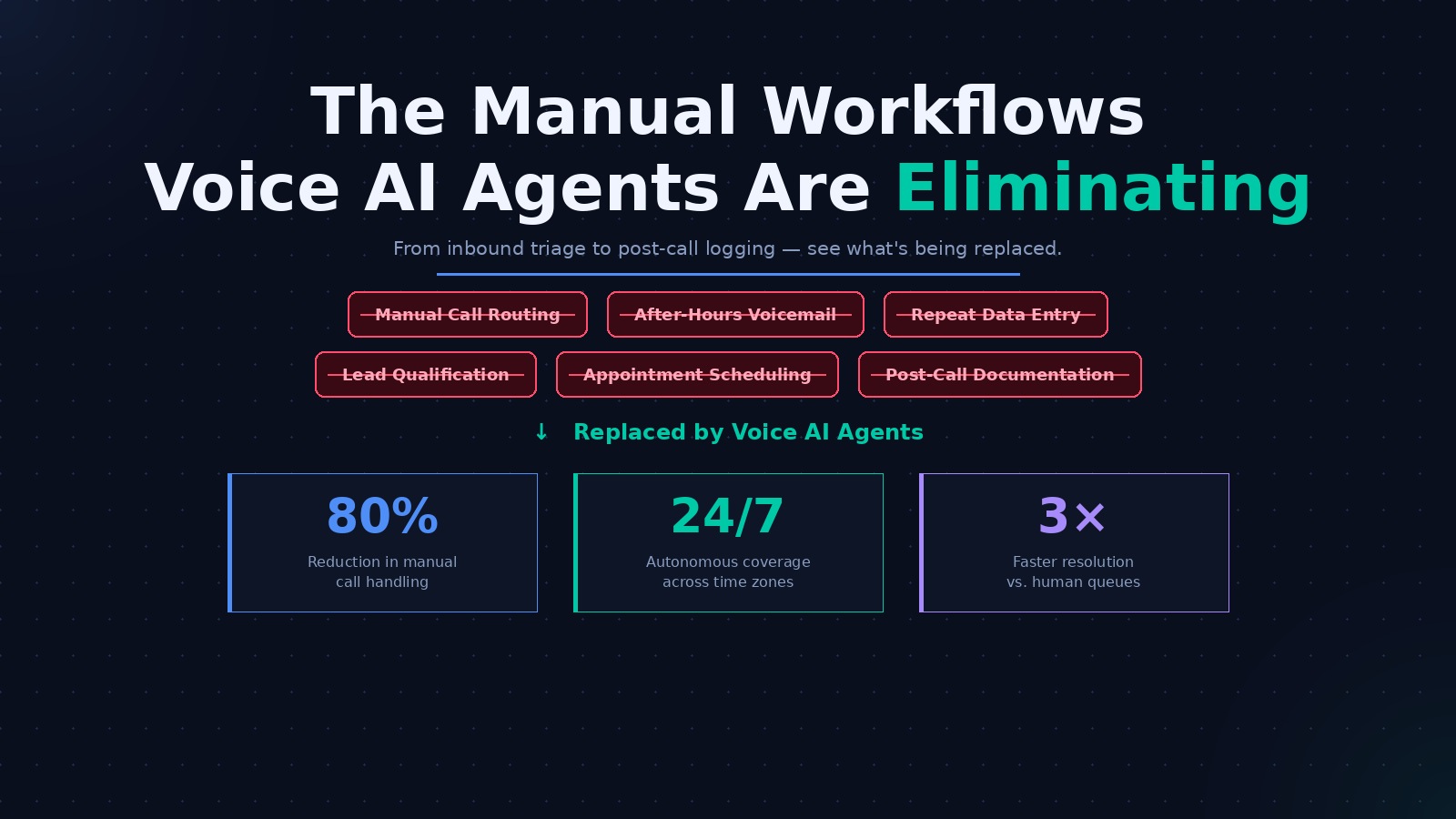
Tier 1: IVR Replacement (Fastest to Deploy)
Legacy touch-tone menus are being replaced with conversational AI that understands natural speech. Customers say what they need instead of pressing numbers. Call routing accuracy improves immediately, and customer frustration drops.
Tier 2: Autonomous Resolution (Where Real Cost Savings Begin)
AI voice agents handle calls end-to-end for defined, repeatable use cases:
- Order status and tracking — customers get real-time updates without agent involvement.
- Appointment scheduling and confirmations — booking, rescheduling, and reminders are handled automatically.
- Account balance and billing inquiries — FAQs and transactional queries resolved in under 60 seconds.
- Password resets and basic IT support — high-volume, low-complexity tickets cleared without a service desk ticket.
Tier 3: Agentic Workflow Execution (The Frontier in 2026)
The most advanced deployments use agentic voice AI to manage entire workflows: calling leads within seconds of form submission, conducting qualification conversations, updating CRM records, and scheduling follow-ups, all without a human in the loop. By 2027, four in ten customer service interactions will be fully automated by agentic voice AI.
Key Metrics Enterprises Are Tracking Post-Deployment
Successful voice AI automation deployments are measured across five core performance dimensions:
| Metric | Impact |
|---|---|
| First Contact Resolution (FCR) | +5 to +15 points |
| Average Handle Time (AHT) | 25–50% reduction |
| Agent Ramp Time | 50–85% reduction |
| Operational Cost per Call | 70–90% reduction |
| Customer Satisfaction (CSAT) | Up 30% on AI-handled calls |
| Call Abandonment Rate | Down by up to 50% |
What Separates Leaders From Laggards in 2026
The organizations succeeding with voice AI automation in 2026 share one defining mindset: they are solving specific business problems.
They identify high-volume, low-complexity workflows where AI can deliver immediate value, validate the economics, and scale systematically. They treat voice AI as an enterprise workflow layer, one that integrates with their CRM, ticketing system, scheduling platform, and compliance infrastructure.
They are also thinking beyond cost reduction. The most forward-looking deployments are using voice AI to drive revenue: mid-call upsell prompts, automated cart recovery, lead qualification at speed-to-lead, transforming contact centers from cost centers into profit centers.
Why Ello is the Best Choice for Enterprises
While many platforms are playing catch-up, Ello was architected with these 2026 trends as foundational pillars.

- Adaptive Prompt Technology: Our agents don’t just follow a script; they rewrite their own playbook in real-time to optimize outcomes, embodying the true spirit of Agentic AI.
- Multi-Agent Networks: Ello utilizes specialized sub-agents to audit and improve conversations at machine speed, ensuring accuracy and continuous learning.
- Low-Latency Infrastructure: We understand that in a voice-first world, speed is trust. Our infrastructure is built for sub-second responses, ensuring conversations feel natural and human.
- Enterprise-Grade Security: With SOC 2 and HIPAA compliance, Ello provides the governance and safety required for the next generation of AI deployment.
- True Multilingual & Dialect Mastery: In a linguistically diverse market like India, businesses traditionally had to hire separate support teams for regional languages. With Ello, you don’t need that. Our agents can switch naturally between languages mid-conversation (e.g., from Hindi to English) just as a native speaker would. This massive consolidation significantly reduces hiring effort and operational costs, allowing a single AI workforce to serve the entire country.
FAQs
Q1. What is Voice AI automation?
Voice AI automation uses artificial intelligence to handle voice-based interactions such as inbound support, outbound calls, appointment scheduling, and customer follow-ups. It enables businesses to automate conversations while maintaining a natural, human-like experience.
Q2. How does Voice AI reduce manual call workflows?
Voice AI automates repetitive tasks like answering FAQs, collecting customer information, qualifying leads, and scheduling appointments. This reduces the workload on human agents and allows teams to focus on complex customer interactions.
Q3. Can Voice AI handle enterprise-scale call volumes?
Yes, modern voice AI platforms can manage thousands of simultaneous conversations without compromising response quality. This scalability helps enterprises handle peak call volumes without increasing staffing costs.
Q4. What industries benefit the most from Voice AI automation?
Industries such as healthcare, banking, insurance, real estate, retail, and customer support see significant benefits from voice AI. These sectors often handle high call volumes and repetitive customer interactions, which are ideal for automation.
Q5. Is Voice AI capable of multilingual communication?
Most enterprise voice AI solutions support multiple languages and regional accents. This allows organizations to provide consistent customer experiences across diverse markets and geographies.
Q6. Does Voice AI integrate with existing business systems?
Yes, enterprise voice AI platforms can integrate with CRM, ERP, helpdesk, scheduling, and communication tools. These integrations enable seamless data exchange and automated workflow execution.