
The Speed to Lead Gap: Why Inbound Leads Go Cold Before Anyone Calls
Speed to lead is the time between a prospect raising their hand (a form, an ad inquiry, a missed call) and your team’s first attempt to reach them. The speed to lead gap is everything that happens in between. In a 2024 test of 1,000 B2B companies, 63.5% never answered a demo request at all.
A prospect fills in a home loan inquiry at 9:40 pm after clicking an ad you paid for. The lead is assigned at 10:30 the next morning and called at 11:15. By then, the prospect has spoken to two other lenders. Nobody did anything wrong on purpose, yet the lead went cold before anyone called.
Most teams treat slow follow-up as a rep discipline problem. In practice, delays hide in handoffs, coverage gaps, and first calls that cannot hold a conversation. This blog covers what speed to lead measures, why leads go cold, the six delay points where the gap opens, how to measure lead response time properly, six ways to close the gap with speed to lead automation, a 30-day rollout plan with India checks, and where AI lead follow-up is heading.
Key Takeaways
- Speed to lead measures the time to the first outreach attempt; speed to contact measures the first real conversation.
- A 2024 test of 1,000 B2B companies found 63.5% never answered a demo request, and responders took over a day on average.
- Most delay comes from handoffs and coverage gaps, not from reps ignoring leads.
- Measure the median and the slowest 10% of leads, not only the average, and split by source and hour.
- An instant lead response only pays off if the first call can qualify the lead and book the next step.
- In India, consent capture, TRAI calling rules, and Hindi or regional-language callers shape how fast you can safely call.
What Is Speed to Lead?
Speed to lead is a sales metric that tracks how quickly a business makes its first outreach attempt after an inbound lead expresses interest. Many teams use it interchangeably with lead response time. The clock starts when the lead is created (a form submission, a chat, a missed call, a click-to-call ad) and stops at the first attempt by phone, SMS, WhatsApp, or email.
Speed to lead sits at the front of inbound lead follow-up, so it shapes every metric after it, and it is where voice AI for lead generation changes the economics, because a machine does not wait for a shift to start.
Speed to Lead vs Related Sales Metrics
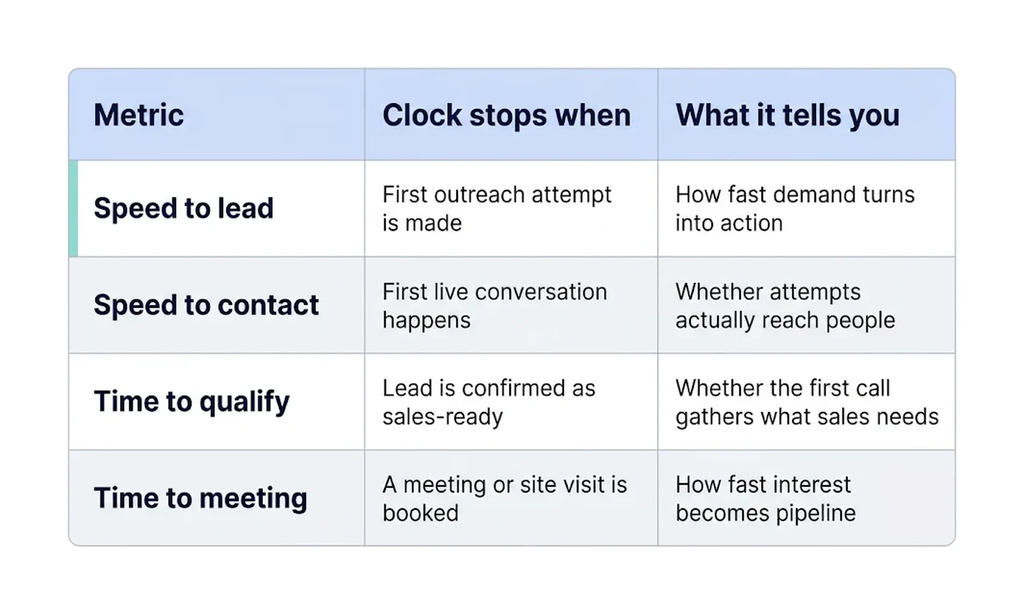
In short: speed to lead measures how fast you try to reach a lead, while speed to contact, time to qualify, and time to meeting show whether that attempt turns into pipeline.
Why Inbound Leads Go Cold: The Cost of a Slow Response
Interest peaks at the moment of inquiry and decays fast, yet most businesses still respond slowly or not at all. In RevenueHero’s 2024 test of 1,000 B2B websites, researchers submitted demo requests and tracked what happened next:
- No response at all: 63.5% of the companies never responded to the demo request.
- Slow when they did respond: the average response time was 1 day, 5 hours, and 17 minutes.
- Weak follow-through: 39% did not follow up after a prospect missed a booked meeting.
For a buyer comparing three vendors, that means the business that calls within minutes is often the only one in the conversation.
The cost shows up in acquisition spend. At ₹400 per lead and a 5% conversion rate, each customer costs ₹8,000 in lead spend. If slow follow-up drops conversion to 3%, the same customer costs about ₹13,300. Teams investing in lead generation automation get little return if response stays slow.
Where the Speed to Lead Gap Opens: 6 Delay Points
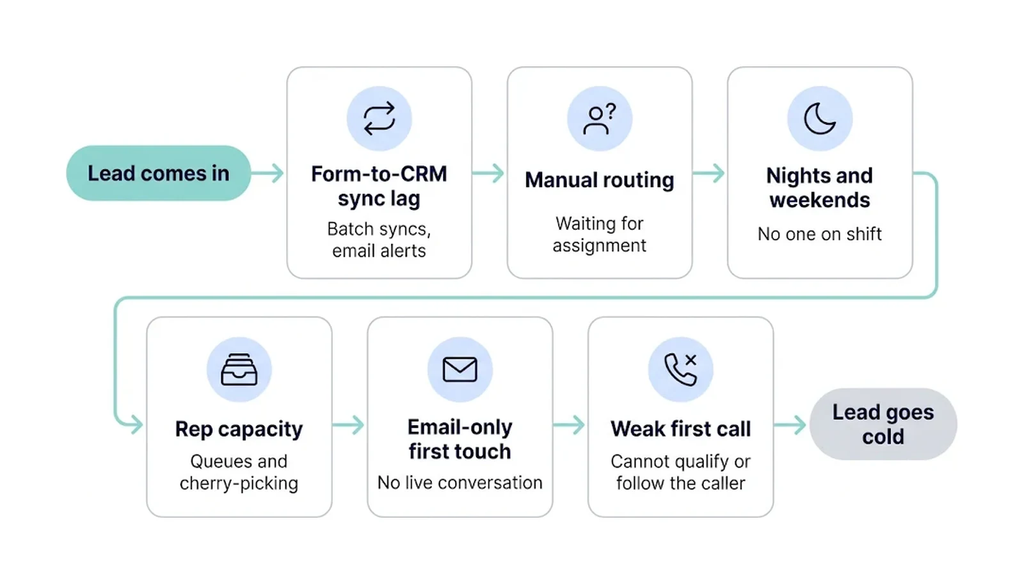
1. Form-to-CRM Sync Lag
Leads from ad platforms and aggregators often arrive through batch syncs or email alerts. A 15-minute sync adds 15 minutes to every lead.
2. Manual Routing and Assignment
When a coordinator assigns leads by hand, response speed depends on that person’s calendar. CRM rules remove the wait.
3. Nights, Weekends, and Holidays
Consumer inquiries in India often peak in evenings and on weekends, when sales floors are empty. A Saturday 8 pm lead may wait until Monday.
4. Rep Capacity and Cherry-Picking
Reps with full queues work the most promising leads first, and some sources get worked last or never.
5. Email-Only First Touch
A templated email counts as a response on paper, but high-intent buyers usually want a call. Email-only teams post good numbers while live conversations stay low.
6. A First Call That Cannot Hold the Conversation
Reaching the lead quickly is wasted if the caller cannot answer questions, qualify, or follow a prospect who switches between Hindi and English.
| Delay point | Typical cause | Fix |
|---|---|---|
| Form-to-CRM sync | Batch syncs, email alerts | Real-time webhook into CRM |
| Manual routing | Human assignment | Rules-based assignment |
| Off-hours | No coverage | AI agent coverage after hours |
| Rep capacity | Queue spikes | Automated first call, human follow-up |
| Email-only touch | Easy to send | Call first, then message |
| Weak first call | No qualification, language gaps | Qualify and book on the first call |
How to Measure Lead Response Time
The basic formula is simple: speed to lead = time of first outreach attempt minus time the lead was created. For a period, calculate it for every lead, then report:
- Median, not only average: one weekend backlog distorts an average; the median shows the typical lead’s wait.
- Slowest 10% of leads: the 90th percentile shows where leads fall through.
- Clock hours: buyers do not pause at 7 pm, so measure the time they actually waited.
- By source and hour: one number hides a fast web form queue and a slow aggregator queue.
- Never-contacted rate: leads with no attempt must count, not vanish from the average.
- Results by response band: compare contact and qualification rates for leads reached in under 5 minutes, 5 to 30 minutes, and later.
Speed to Lead Response Time Targets by Lead Type
| Lead type | First attempt target | Follow-up if unanswered |
|---|---|---|
| Demo, quote, or callback request | Under 5 minutes | Retry within 30 minutes, then SMS or WhatsApp |
| Missed inbound call | Under 2 minutes | One retry, then a message with a callback option |
| Paid ad inquiry | Under 5 minutes | Two more attempts the same day |
| Content download or webinar sign-up | Same business day | Nurture sequence plus one call |
These are operating targets, not industry benchmarks; refine them using your own response bands.
6 Ways to Close the Gap with Speed to Lead Automation
1. Trigger the First Call from the Lead Event
Connect forms, ad platforms, and click-to-call numbers to the CRM through real-time webhooks, so the lead event itself triggers an instant lead response.
2. Route by Rules, Not by Inbox
Automatically assign leads by product, region, language, and deal size. If the rep cannot call within the target window, reassign or hand the first call to an automated agent.
3. Cover Nights and Weekends
An AI voice agent can call or answer leads outside office hours, qualify them, and book a callback for the morning team. The same approach powers AI receptionist agents for missed inbound calls.
4. Call First, Then Message
Make a call the first touch for high-intent leads, then follow with SMS, WhatsApp, or email. A defined attempt cadence is the backbone of inbound lead follow-up.
5. Qualify and Book on the First Call
Use the first conversation to confirm need, budget, timeline, and decision-maker, then book the meeting or site visit before the call ends. Pairing this with conversational AI lead scoring lets sales see which leads are ready now.
6. Write Every Outcome Back to the CRM
Lead response automation fails quietly when outcomes stay in a dialer report. Automatically update the record, next step, and call summary so reps start with full context.
How to Roll Out Lead Response Automation in 30 Days
- Week 1: Measure current speed to lead by source and hour using median, 90th percentile, and never-contacted rate.
- Week 1: Map every lead source and remove batch syncs and email-only handoffs.
- Week 2: Set routing rules and response targets per lead type, and agree when the AI agent takes the first call.
- Week 2: Write the qualification questions and booking rules sales needs before handing over a lead.
- Week 3: Switch on AI lead follow-up for one source, such as after-hours paid inquiries, and listen to the first 100 calls.
- Week 4: Compare contact, qualification, and meeting rates against the baseline, then extend to the next source.
India Checks: Consent, Calling Hours, and Language
- Consent: capture clear consent on every form for calls and messages, and log it with the lead. Under India’s Digital Personal Data Protection (DPDP) Act, the enterprise remains accountable for how it uses lead data.
- Calling rules: TRAI’s rules restrict promotional calls to 9 am to 9 pm. Confirm with your compliance team how the lead-requested callbacks are classified, and keep DND checks in the workflow.
- Language: route by the language the lead used, and make sure the first call can handle Hindi, English, and regional languages mixed in one sentence. The case for multilingual voice AI in India rests heavily on this.
Where Speed to Lead Is Heading: AI Agents on Every Inbound Lead
- Seconds become the standard: as more competitors automate the first call, a five-minute response stops being fast and becomes the minimum.
- Agents that act, not just dial: agentic voice AI qualifies, books, and updates systems during the call, so speed to lead and time to meeting collapse into one conversation.
- Response quality as a metric: teams will track whether the first call answered the buyer’s questions, not only how fast it happened. Low AI voice agent latency matters here because pauses make callers hang up.
For sales teams, reps stop chasing cold leads and spend their day on qualified conversations and negotiations. For a wider view of how this changes selling, see conversational AI for sales.
The Ello Advantage: Reaching Every Lead While Intent Is High
Ello is an enterprise-grade AI voice agent platform built to close the speed to lead gap: it holds a natural conversation with every lead, completes the next step in your systems during the call, and learns from every outcome.
- Adaptive Prompting Engine: dynamic, non-scripted dialogue; handles interruptions; reads sentiment and urgency in real time.
- Voice-to-Action Engine: completes tasks in CRMs, ERPs, ATS, and PMS platforms while the caller is still on the line, through 40+ integrations including Salesforce, HubSpot, Slack, and Zapier.
- Multilingual Vernacular Native: native support for 100+ languages with accent adaptation, including code-switching common on Indian calls.
- Self-Evolving Architecture: studies call outcomes and rewrites its own prompts, with guardrails, compliance checks, and audit trails on every change.
- Multi-Agent Quality Control: specialized AI agents audit and improve each other’s performance.
- Speed and Reliability: sub-500ms response latency and a 99.99% uptime SLA; powers 50,000+ calls daily.
- Enterprise Security Standards: SOC 2 Type II attested, with encryption, hallucination guardrails, and automated checks for TRAI DND registrations and calling-hour rules that help enterprises meet their regulatory duties.
Real-time call monitoring and custom reporting dashboards show contact and qualification rates by source and language. For a broader look at automated outreach, read our blog to AI outbound calling.
See how Ello calls, qualifies, and books inbound leads in English, Hindi, and regional languages: Book an Ello voice AI demo.
Frequently Asked Questions
1) What is a good speed to lead?
A good speed to lead for high-intent inbound leads is under five minutes, with a call as the first touch. Most B2B companies take over a day or never respond, so a team that calls within minutes is usually first in the conversation.
2) What is the difference between speed to lead and lead response time?
They usually mean the same thing: the time from lead creation to the first outreach attempt. Some teams use lead response time more broadly for every reply in a conversation. Speed to contact is different, because it measures when the first live conversation actually happens.
3) How does speed to lead automation work?
Speed to lead automation connects lead sources to the CRM in real time, assigns each lead by rules, and triggers an immediate call or message. AI voice agents can then qualify the lead, book the next step, and write the outcome back to the CRM.
4) Can AI lead follow-up handle Hindi and regional-language leads?
Yes, when the AI voice agent understands code-switched speech and responds in the lead’s language. Many Indian prospects mix Hindi or a regional language with English, so routing by language and supporting code-switching protects contact and qualification rates.
5) Is it legal to call inbound leads instantly in India?
Usually yes, when the lead gave clear consent on the form, and the call relates to their inquiry. Enterprises must still log consent under the DPDP Act, run DND checks, and follow TRAI rules on promotional calling hours, so confirm classification with your compliance team.
Conclusion
Speed to lead is rarely lost by lazy reps. It is lost in sync delays, manual routing, empty evenings, and first calls that cannot hold a conversation. Teams that measure the slowest leads, automate the first touch, and qualify on that call stop paying for leads that go cold.
When the first call happens within minutes, speaks the lead’s language, and books the next step, speed to lead stops being a reporting metric and becomes a revenue advantage.