
Why Businesses Are Adopting AI Receptionist Agents in 2026
High call volumes, missed inbound inquiries, and rising front-desk staffing costs continue to strain businesses of every size. Missed calls translate directly into lost revenue, and most callers who reach an unanswered office line hang up rather than leave a voicemail. Traditional phone trees force callers through rigid button-press menus, frustrate them, and overwhelm front-desk staff with repetitive inquiries. An AI receptionist agent removes these bottlenecks by replacing static auto-attendants with conversational voice workflows that manage multi-turn dialogue, understand what the caller needs, and update business systems in real time.
Callers today expect an immediate, accurate answer. Organizations are retiring manual call routing and text-only bots in favor of an AI receptionist agent that works as a digital teammate over standard phone lines. For leaders new to the technology, it helps to start by understanding what a voice AI agent is and how it differs from a traditional phone system.
What Is an AI Receptionist Agent?
An AI receptionist agent is voice software that answers business calls in natural language, 24/7. It handles routine requests such as booking appointments, answering FAQs, and routing calls; updates calendars and CRMs during the call; and transfers complex or sensitive calls to staff with full context.
Key takeaways
• AI receptionist agents answer every call instantly, including after hours and during peak times.
• They book appointments, update CRMs, and send confirmations while the caller is still on the line.
• Complex, urgent, or sensitive calls go to a person, with a full transcript and summary.
The Operational Breakdown of Traditional Front-Desk Operations
Front desks rely on human receptionists or legacy auto-attendant systems to manage inbound calls, and both approaches create significant bottlenecks during peak hours.
When multiple callers dial an office at once, human receptionists must place inquiries on hold, balance in-person guests with incoming calls, and manually enter data into scheduling software. This friction leads to three common problems:
- High Call Abandonment Rates: The longer callers wait on hold, the more likely they are to hang up, leading to lost sales prospects and reduced client satisfaction.
- Coverage Gaps Outside Business Hours: After-hours or weekend inbound calls typically route to static voicemail systems, where callers often wait until the next business day or longer for a response.
- Manual Scheduling Errors: Staff members coordinating appointment times across fragmented calendars introduce double-booking risks and inconsistent caller data entry.
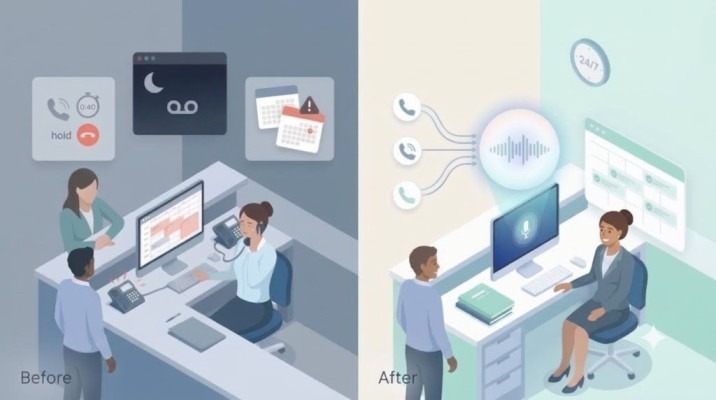
Moving to a virtual AI receptionist closes the gap between inbound calls and immediate resolution by replacing passive voicemail with real-time, interactive conversations.
Here is how the three options compare:
| Factor | Human receptionist | Auto-attendant (IVR) | AI receptionist agent |
|---|---|---|---|
| Availability | Business hours only | 24/7, but only routes calls | 24/7, and resolves routine requests |
| Call capacity | One call at a time | Many calls, but long menus | Many calls at once, with no hold queue |
| Appointment booking | Manual, in separate calendars | Not possible | Books, reschedules and confirms by SMS during the call |
| Languages | Limited to staff skills | A separate menu per language | 100+ languages, including mid-call switching |
| Cost | Salary, training and cover for absences | Low, but frustrates callers | Usage-based pricing, far below adding headcount |
| Handoff | Takes a message or transfers manually | Transfers without context | Warm transfer with transcript and summary |
Core Drivers Accelerating Business Adoption of AI Receptionist Agents
Businesses adopt AI receptionists because they turn incoming calls from a bottleneck into a reliable revenue channel. In 2026, faster speech models and sub-500ms response times have made voice AI natural enough for customer-facing calls, while rising front-desk staffing costs make the case for automation harder to ignore. Instead of hiring extra staff to cover peak hours, organizations can scale call capacity instantly without adding headcount.
24/7 Autonomous Call Handling
Business inquiries do not stop when physical offices close. A 24/7 AI receptionist ensures every incoming call gets an immediate, helpful response, regardless of time zone or business hours. The system verifies callers, provides accurate information from the company’s knowledge base, and resolves routine requests on its own.
Real-Time Calendar Syncing and Appointment Scheduling
An AI receptionist must perform backend actions while talking with a caller. It can check staff or service provider availability across Google Calendar or Microsoft Outlook, agree on a convenient time slot, log the confirmed booking in the CRM, and send an SMS confirmation before the call ends. With lead generation automation, sales and scheduling teams can turn inbound inquiries directly into qualified meetings.
Contextual Intent Recognition and Intelligent Routing
Unlike traditional Interactive Voice Response (IVR) systems that rely on rigid keypad menus, an AI receptionist agent understands natural human speech. If a caller asks about pricing, location details, and appointment availability in a single sentence, the AI breaks down the request, addresses each part in turn, and routes complex cases to the right team with a complete summary.
How an AI Receptionist Agent Handles a Call
A low-latency AI receptionist agent combines speech recognition, language understanding, and connections to business systems. Each call follows the same five steps:
- Answers instantly: The call connects with no hold queue, and audio streams to the AI in real time.
- Understands the request: Speech-to-text converts the caller’s words, and the language model identifies what they need.
- Takes action: The agent checks the calendar, CRM, or knowledge base, and books, updates,s or looks up what the caller asked for.
- Responds naturally: Text-to-speech replies in a natural voice in under 500 milliseconds.
- Confirms or transfers: The agent confirms the outcome by SMS or email, or transfers the call to a person with a full summary.
Low-Latency Conversational Turn-Taking
In natural conversation, people respond to each other almost instantly, with pauses that typically last only a fraction of a second. Early automated voice systems introduced noticeable pauses between speech input and machine output, resulting in awkward calls. Modern platforms manage AI voice agent latency by streaming audio via WebSockets, keeping total response time below 500 milliseconds for natural, fluid dialogue.
Managing Interruptions and Dynamic Reasoning
Callers rarely follow a script. A caller may start providing their contact information, interrupt mid-sentence to ask about parking, and then resume booking an appointment. Advanced AI receptionists keep track of the whole conversation, handling interruptions immediately without losing context or repeating prompts.
Vernacular Adaptability and Accent Processing
Businesses serve callers from many regions and language backgrounds. Multilingual voice AI lets front-desk voice platforms handle accent variations, regional dialects, and mid-call language switching without forcing callers through restrictive language menus.
Industry Use Cases: Where Businesses Are Deploying AI Receptionists
Organizations across diverse sectors use an AI receptionist agent to automate high-volume inbound calls:
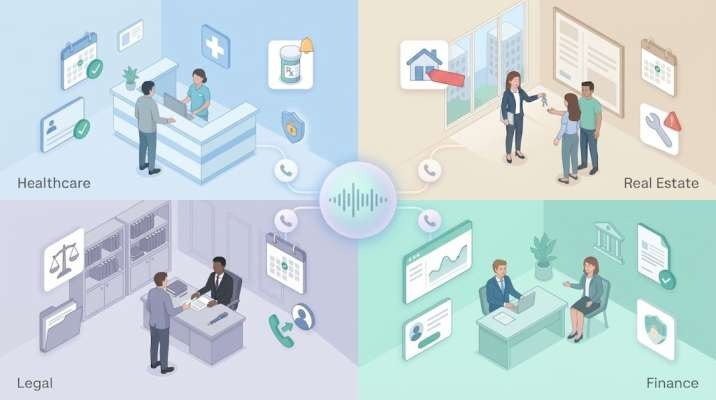
- Healthcare and Medical Practices: Managing patient intake, verifying insurance coverage details, booking clinical appointments, and issuing automated prescription pickup notifications while maintaining strict HIPAA data security.
- Real Estate and Property Management: Answering property availability queries, qualifying prospective buyers based on budget, logging emergency tenant maintenance requests, and scheduling on-site property viewings. Teams using an AI voice agent streamline property inquiries while maintaining continuous coverage.
- Professional and Legal Services: Vetting incoming client consultations, capturing case details, booking billable calendar appointments, and routing urgent matters directly to available attorneys.
- Financial Services and Insurance: Handling routine balance inquiries, updating policyholder contact records, processing preliminary claims intakes, and scheduling consultations with financial advisors. As firms adopt enterprise conversational AI, voice automation helps them balance security and efficiency.
How to Set Up an AI Receptionist Agent
Most businesses can launch an AI receptionist in a few weeks by following four steps:
- Map your call types: List the calls your front desk handles most, and mark which are routine and which need a person.
- Connect your systems: Link the calendar, CRM, and knowledge base the agent will use to answer and book.
- Set escalation rules: Decide which calls transfer to staff, such as urgent, sensitive,e or high-value requests.
- Test, launch and refine: Start with one call type, review transcripts and results, then expand to more calls.
Security, Compliance, and Hallucination Containment
Using AI on customer calls requires firm guardrails and strong data privacy protections.
- Deterministic Regulatory Guardrails: Fixed business rules sit above the language model, ensuring that an AI receptionist agent sticks to approved policies, verified knowledge sources, and required disclosures without making off-policy statements.
- Enterprise Security Standards: Voice pipelines support SOC 2 compliance, HIPAA compliance for healthcare data, and strict encryption for audio data in transit and at rest.
- Data Privacy and Calling Compliance: Outbound phone workflows adhere to regional telecommunications regulations, including Do Not Disturb (DND) registries, TCPA rules, and local calling-window restrictions, while inbound calls follow the same data privacy and call-recording consent standards. When assessing an agentic voice AI framework, organizations should confirm that proper data safeguards extend across every automated call workflow.
The Ello Advantage: Enterprise-Grade AI Receptionist Technology
Basic phone software offers call forwarding or voice messaging, but a dedicated AI voice agent platform handles bookings, integrations, and handoffs end to end. Ello is an enterprise voice AI platform for high-volume inbound calls:
- Learns from every call: Ello analyzes call outcomes and refines how it handles conversations within approved boundaries, with full audit logging and no manual developer updates.
- Acts during the call: Ello handles interruptions and urgent callers, verifies identity, and completes tasks directly in Salesforce, Zendesk, Workday, and HubSpot while staying live on the line.
- Multilingual and secure: Ello supports 100+ languages and regional accents, responds in under 500 milliseconds, and is SOC 2- and HIPAA-compliant, with end-to-end encryption and built-in telecom compliance controls.
Frequently Asked Questions
1) How does an AI receptionist agent differ from a traditional auto-attendant?
Traditional auto-attendants rely on keypad inputs to route calls to fixed extensions or voicemail boxes. An AI receptionist agent holds a natural conversation, answers questions from the company’s knowledge base, and completes tasks like booking appointments during the call.
2) Can a virtual AI receptionist integrate with existing calendars and CRMs?
Yes. AI receptionists connect via APIs to calendar systems like Google Calendar and Microsoft Outlook, and to CRMs like Salesforce, HubSpot, and Zendesk, updating caller records and booking appointments in real time.
3) How does a conversational AI receptionist handle complex or angry callers?
It listens for urgency and frustration in what the caller says and how they say it. If a request is outside its limits or needs a person, it performs a warm transfer to a staff member, passing along a transcript and call summary.
4) Is an automated phone receptionist capable of handling after-hours calls?
Yes. With 24/7 call handling, the system answers after-hours calls immediately, escalates emergencies according to on-call protocols, and books routine appointments around the clock.
5) How do voice platforms protect data privacy and compliance during phone calls?
Business voice platforms use security controls such as SOC 2 compliance, end-to-end encryption, HIPAA safeguards for medical records, and fixed rules that prevent unauthorized data access or unverified answers.
6) How much does an AI receptionist cost?
It depends on call volume, call length, integrations, and the vendor’s pricing model, usually per minute, per call, or via a monthly plan. For most businesses, it costs far less than hiring additional front-desk staff, especially for after-hours and peak-time coverage.
7) Will callers know they are talking to an AI?
They should. Modern AI receptionists sound natural, but best practice is to tell callers at the start of the call that they are speaking with an AI, and regulations in many regions require this disclosure. Callers should always be able to ask for a person.
8) Is an AI receptionist better than an answering service?
For most routine calls, yes. An answering service takes messages for staff to follow up on, while an AI receptionist resolves requests during the call, such as booking appointments or answering questions. Many businesses keep human staff for complex or sensitive calls.
9) Is an AI receptionist HIPAA compliant?
It can be, depending on the vendor. Healthcare providers should choose a HIPAA-compliant platform that encrypts call data and will sign a Business Associate Agreement (BAA). Ello is SOC 2 and HIPAA compliant.
Conclusion
Moving from manual phone management and static auto-attendants to AI voice agents is an essential step for modern front desks. As call volumes grow, relying on manual message-taking creates friction, increases missed opportunities, and inflates staffing costs. By combining low-latency speech processing, real-time calendar booking, and live CRM updates, an AI receptionist agent lets organizations deliver an immediate, high-quality phone experience for every caller. Modernizing phone systems eliminates front-desk bottlenecks, captures lost revenue, and frees teams to focus on higher-value work. To learn how AI voice agents can transform your phone operations, explore Ello’s enterprise voice platform.