
AI Interview Scheduling: Automating Calls with Voice AI
Extended hiring cycles, high interview drop-off rates, and administrative coordination delays continue to drain talent acquisition velocity across high-volume enterprise organizations. Manual candidate scheduling takes up a large share of a recruiter’s working week, creating delays that cost enterprises top-tier candidates. When candidates must wait days for a recruiter to share availability, back-and-forth email loops often lose talent to faster-moving competitors.
Traditional email-based coordination tools and self-service booking links fail to solve this friction. Passive scheduling pages require candidates to check inbox notifications and manually choose time slots, leaving non-responsive candidates stalled in hiring pipelines.
Modern AI interview scheduling eliminates these bottlenecks by replacing manual outreach with proactive, conversational voice workflows. Instead of waiting for candidates to open an email, real-time voice systems initiate phone calls, answer questions about role requirements, negotiate mutually available time slots across interviewer calendars, and instantly update Applicant Tracking Systems (ATS). Automated candidate scheduling workflows let talent acquisition teams convert qualified applicants into scheduled interviews within minutes of application submission.
What is AI Interview Scheduling?
AI interview scheduling is the use of software, often powered by machine learning or voice AI agents, to automate the back-and-forth of arranging interviews between candidates and hiring teams.
It reads interviewers’ calendars, finds times that work for everyone (including multi-person panels), and contacts candidates by email, SMS, WhatsApp, or voice to offer slots and confirm bookings. It also handles rescheduling, sends reminders, and syncs everything back to the applicant tracking system, so recruiters don’t have to manage the back-and-forth themselves.
The Structural Breakdown of Manual Recruitment Coordination
High-volume hiring environments in logistics, retail, healthcare, and technology demand rapid candidate engagement. Yet, standard recruiting workflows rely on fragmented, asynchronous communication channels.
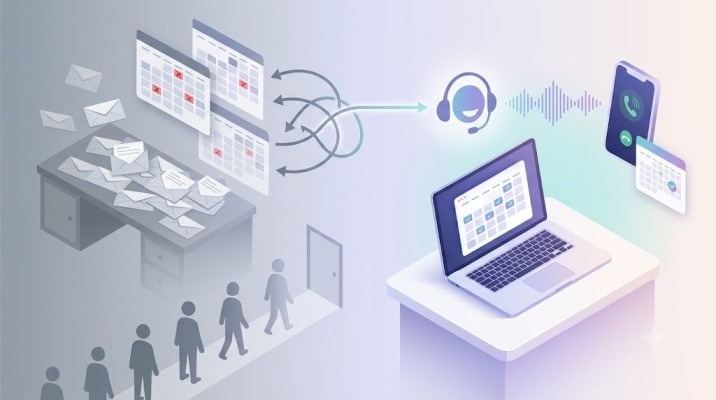
When a candidate applies or clears an initial resume screening, recruiters typically send email templates containing static calendar links. This asynchronous friction creates several points of systemic operational failure:
- Inadequate Contact Rates: A large share of scheduling emails go unopened or sit unanswered for days, while a direct phone call reaches candidates immediately.
- Complex Multi-Interviewer Coordination: Aligning multiple panel interviews across executive calendars using static forms leads to frequent double-bookings and back-and-forth delays.
- High Candidate Drop-Off: Delays between initial screening and formal interview confirmation degrade candidate sentiment, leading applicants to accept alternative offers.
Transitioning toward automated interview scheduling software bridges the gap between candidate application and interview confirmation by replacing passive forms with dynamic, real-time voice interactions.
How Voice AI Transforms Candidate Outreach and Coordination
Unlike static scheduling forms, voice AI agents act as virtual recruiting coordinators that hold natural, back-and-forth conversations over standard phone lines.
Proactive Candidate Phone Outreach
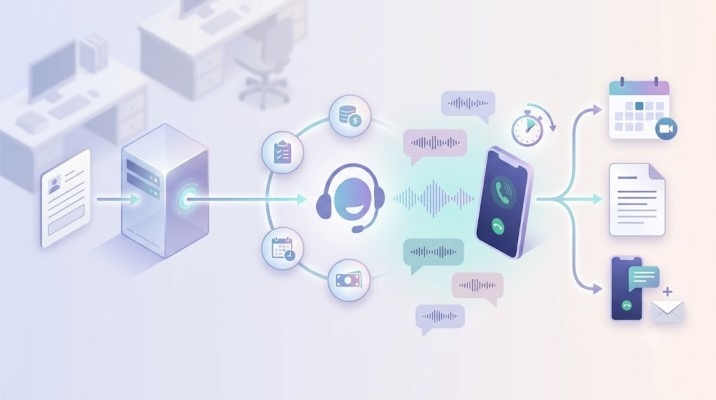
When an ATS like Greenhouse, Workday, or Lever marks an applicant as qualified, the system automatically triggers an outbound call from an automated voice assistant. The agent introduces the company, confirms the candidate’s availability, and verifies continued interest in the open position.
Dynamic Calendar Negotiation and Interruption Handling
Candidates rarely respond predictably during scheduling calls. A candidate might state they are free on Tuesday afternoon, then interrupt mid-sentence to correct their availability or ask about remote work policies. Advanced voice engines keep track of the conversation even when candidates change their answers or jump between topics, so the call stays natural and on track.
Voice-to-Action ATS Integration
Scheduling an interview requires more than checking calendar availability. An effective voice system executes backend actions while live on the call: verifying interviewer permissions, booking Outlook or Google Calendar invites, generating secure video conferencing links, updating candidate stage statuses inside the ATS, and sending SMS confirmations.
Technical Foundations of Voice-Driven Candidate Screening
Implementing AI recruitment automation solutions requires unifying natural language understanding with enterprise data pipelines.
The pipeline starts the moment a candidate applies. The application triggers an event in the ATS, which launches the voice agent’s outreach call, and the ATS receives every outcome from that call. Three capabilities make this work at enterprise scale.
Specialized Agents for Each Task
Enterprise hiring involves specialized recruitment steps. A primary triage agent initiates contact, while specialized micro-agents handle specific sub-tasks: pre-screening basic job qualifications, negotiating panel interviewer availability, or answering compensation and benefits queries.
Vernacular Adaptability and Accent Processing
Global enterprise recruiting operations engage candidates across diverse geographic regions. Deploying multilingual AI voice agents for recruitment ensures systems handle colloquial phrasing, regional accents, and language code-switching natively without requiring menu navigation.
Managing Latency and Real-Time Reasoning
Natural verbal interaction requires fast turn-taking intervals. High latency causes awkward pauses that diminish candidate trust. Keeping voice latency under 500 milliseconds ensures candidate calls feel natural, professional, and efficient.
Enterprise Security, Compliance, and Data Privacy
Deploying voice automation across recruitment pipelines requires strict adherence to global labor regulations and data security standards.
- Fixed Compliance Guardrails: Fixed compliance rules sit on top of the AI’s flexible reasoning, ensuring systems strictly adhere to pre-approved interview questions and regulatory disclosures without improvising off-policy statements.
- Data Privacy Standards: Ello is SOC 2 Type II certified and supports GDPR and regional telephony guidelines (such as calling hour restrictions and DND registry checks). Candidate audio data is encrypted in transit and at rest with customizable retention windows.
- Consistent Candidate Treatment: Voice systems follow the same structured workflow for every candidate, supporting consistent and fair treatment during initial scheduling and pre-screening calls.
- Candidate Consent: Outreach calls and messages go only to candidates who opt in to phone and SMS contact during their application.
The Ello Advantage: AI Interview Scheduling Built for Enterprise Talent Teams
While general scheduling applications handle simple calendar links, choosing a dedicated platform requires infrastructure that can automate complex, multi-system recruitment operations. Evaluating an AI voice agent platform involves assessing real-time execution capabilities.
Designed specifically for enterprise hiring environments, Ello moves past static forms to deliver fully autonomous voice coordination across high-volume recruitment:
- Self-Evolving Architecture: Ello features an adaptive learning loop that continuously analyzes conversational telemetry and candidate booking rates. Within approved corporate boundaries and with full audit logging, the platform refines its prompting parameters after about 200 candidate calls, boosting scheduling completion efficiency by 30% without manual developer updates.
- Adaptive Prompting & Voice-to-Action Engine: Ello’s native reasoning engine dynamically handles candidate interruptions, questions regarding role expectations, and complex calendar changes. The platform authenticates candidates and executes scheduling tasks directly inside ATS platforms (Workday, Greenhouse, Lever, SmartRecruiters) while remaining live on the call.
- Multilingual Vernacular Native: Ello natively supports 30+ languages and hundreds of regional accents, handling fluid code-switching and local colloquialisms seamlessly across global talent pools.
- Enterprise Security Standards: Built with enterprise-grade guardrails, Ello is SOC 2 Type II certified, enforces end-to-end data encryption, maintains strict hallucination containment policies, and provides built-in controls to support compliance with local telecommunication mandates.
Frequently Asked Questions
1) How does AI interview scheduling differ from standard calendar links like Calendly?
Standard calendar links require candidates to open an email, navigate a web interface, and manually select a time slot. AI interview scheduling proactively calls candidates, answers position questions, verbally negotiates mutually available times, and logs updates directly in the ATS during the call.
2) Can AI voice agents for recruitment handle multi-interviewer panel schedules?
Yes. Advanced systems use multi-agent orchestration to cross-reference multiple interviewer calendars simultaneously, find overlapping availability, and book panel interviews without manual recruiter intervention.
3) How do voice systems handle candidate questions about salary, remote policies, or benefits during the call?
Voice agents operate within defined corporate knowledge spaces. They retrieve answers only from verified company policy documents and job descriptions, provide accurate information, and redirect complex policy waivers to human recruiters.
4) What happens if a candidate needs to reschedule an interview later?
Candidates can call the dedicated scheduling line or respond to an automated SMS update. The voice agent retrieves their existing ATS record, frees the previously booked calendar slot, and instantly negotiates a new interview time.
5) How do enterprise platforms ensure compliance with recruitment data privacy regulations?
Enterprise voice platforms incorporate deterministic guardrails, SOC 2 Type II certification, and end-to-end data encryption. They enforce strict identity verification before accessing candidate records and follow regional calling-hour restrictions and privacy regulations like GDPR.
Conclusion
Transitioning from manual email outreach to proactive voice automation represents the next major evolution in enterprise talent acquisition. As hiring pipelines demand faster execution, static calendar links create unnecessary candidate drop-off and recruiter fatigue. By combining low-latency speech processing, dynamic reasoning, and real-time ATS execution, enterprise organizations eliminate administrative bottlenecks while providing candidates with an immediate, professional engagement experience.
Organizations that modernize their recruitment workflows with self-evolving voice architectures reduce time-to-hire metrics, increase candidate booking conversion, and enable talent teams to focus on strategic evaluation. To explore how autonomous voice agents can elevate your enterprise hiring infrastructure, visit Ello’s enterprise voice platform.