
How AI Is Changing Debt Collection for Lenders and BFSI Teams
Rising overdue retail loans, low call-connect rates, and escalating call center costs continue to erode margins across banks, NBFCs, and digital lenders. Traditional recovery operations rely on manual outreach, static call lists, and rigid script-based reminders that yield low contact rates while driving up operational overhead.
Lenders and BFSI teams are turning to AI debt collection to modernize recovery workflows and eliminate these bottlenecks. By integrating conversational voice AI agents, real-time sentiment detection, and automated payment links, financial institutions can engage borrowers respectfully, scale outreach capacity, and accelerate repayment velocity while staying compliant with RBI calling hours and DPDP Act rules.
What is AI debt collection?
AI debt collection uses conversational voice agents, predictive analytics, and automated payment workflows to remind borrowers, negotiate repayment, and collect overdue loans at scale. In India, lenders use it for EMI reminders and early-stage recovery in regional languages, within RBI calling-hour and call-recording rules and DPDP data-protection requirements.
The financial services sector is undergoing a fundamental transformation in how it manages non-performing assets and early-stage delinquencies. For decades, debt recovery relied heavily on manual outreach, static call lists, and rigid script-based reminders. Today, rising transaction volumes and shifting consumer communication preferences make traditional recovery workflows inefficient and costly.
Lenders and BFSI teams are turning to AI debt collection to modernize recovery operations. By integrating voice AI agents, real-time sentiment analysis, and automated payment workflows, financial institutions can engage borrowers respectfully, scale outreach capacity, and increase repayment rates while maintaining strict regulatory compliance.
The Limitations of Traditional Debt Collection Workflows
Legacy collection operations face systemic bottlenecks that limit recovery performance and inflate operational overhead. Manual collection calls require substantial human capital but yield low contact rates because of call blocking, unknown numbers, and rigid schedules.
Key structural challenges in traditional debt collection include:
- High Operational Costs: Scaling human collection teams to handle growing loan portfolios creates linear cost growth without guaranteeing proportional recovery yields.
- Low Contact Rates: Manual dialing teams spend much of their time listening to ringtones, voicemails, or disconnected numbers instead of having meaningful conversations.
- Inconsistent Compliance: Relying on human agents to follow complex regulatory scripts across thousands of daily calls increases the risk of violating consumer protection guidelines, timing restrictions, and disclosure rules.
- Suboptimal Customer Experience: Aggressive or repetitive manual calls can damage brand trust, driving delinquent borrowers to avoid contact entirely rather than working out a payment plan.
How AI Debt Collection Works
AI debt recovery follows the same six steps for every account, from the first reminder to the final record:
- Segment: The system groups accounts by days past due, loan type, repayment history,ry and risk.
- Schedule: It picks the best time and channel to reach each borrower, within permitted calling hours.
- Converse: A voice AI agent calls the borrower in their preferred language, explains the overdue amount, and answers questions.
- Collect: The agent offers approved repayment options and sends a secure payment link by SMS or WhatsApp during the call.
- Escalate: The system transfers disputes, hardship requests, or distressed borrowers to a human collector with full context.
- Log: Record, transcribe, and sync every call to the loan management system for audit and follow-up.
Core Capabilities of AI-Powered Debt Collection
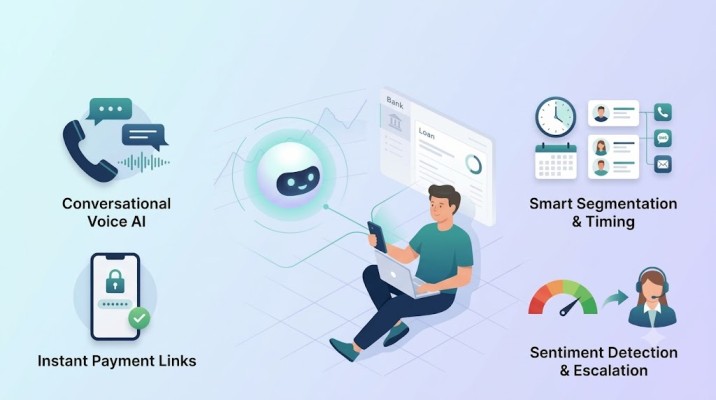
Integrating AI-powered debt collection into existing loan management and core banking systems replaces blunt outreach tactics with data-driven, empathetic communication. Modern collections architectures leverage real-time voice synthesis, natural language understanding, and predictive analytics to resolve debts faster.
1. Conversational Voice AI
Voice AI agents conduct human-like, two-way phone conversations with delinquent borrowers. Unlike legacy IVR systems that force users through rigid keypad menus, conversational voice agents interpret intent, answer borrower questions about outstanding balances, and dynamically negotiate structured payment plans.
2. Smart Segmentation & Timing
Automated debt collection platforms analyze historical repayment behavior, debt age, loan type, and communication history to segment accounts. The system determines the optimal channel, time of day, and outreach tone for each borrower, maximizing engagement while respecting borrower preferences.
3. Instant Payment Links
During live calls or follow-up messaging, voice AI agents generate secure payment links via SMS or WhatsApp. Borrowers can complete instant settlements or set up UPI AutoPay and e-NACH recurring mandates without speaking to a human representative or navigating complex online portals.
4. Sentiment Detection & Escalation
When a voice AI agent detects high emotional friction, complex dispute claims, or hardship requests, it seamlessly transfers the live call, along with full context, the call transcript, and customer history, to a specialized human supervisor.
Business Impact: Why Lenders Are Scaling Voice AI
Adopting voice AI for automated collection calls delivers clear quantitative and qualitative advantages across early-stage EMI reminders, late-stage recovery, and agency management.
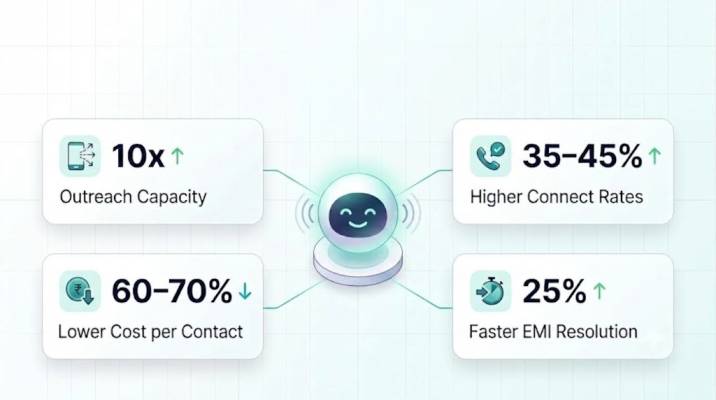
- 10x Outreach Capacity: Voice AI agents reach thousands of account holders at once during optimal engagement windows, without a matching increase in headcount.
- 35–45% Higher Connect Rates: Smart scheduling and localized outreach reach borrowers when they’re most likely to answer, compared with manual dialing.
- 60–70% Lower Cost per Contact: Automating routine outreach for early-stage delinquencies sharply reduces cost per contact compared with manual agent calls. By reducing average handle time, contact center automation lets human collection representatives focus on complex, high-value accounts that require judgment and custom restructuring.
- 25% Faster EMI Resolution: Real-time reasoning lets the agent offer pre-approved settlement terms or installment options and send a payment link in a single conversation, helping resolve overdue EMIs before they roll into late-stage delinquency.
- Consistent Compliance at Scale: Automated systems strictly adhere to predefined script guidelines, disclosure requirements, and local outreach regulations on every call. The system automatically records, transcribes, and audits every interaction, supporting the RBI, DPDP, and TRAI requirements covered below.
AI vs Traditional Debt Collection
Here is how AI collections compare with traditional, agent-led collections:
| Factor | Traditional collections | AI debt collection |
|---|---|---|
| Cost | Grows with every agent hired as the loan book grows | Routine outreach is automated, so cost per contact stays low as volumes rise |
| Contact rate | Fixed dialing schedules and manual retries, so many calls go unanswered | Calls are timed to each borrower’s likely availability, with automatic retries |
| Compliance | Depends on each agent following scripts and calling hours | Calling hours, disclosures, and call recording are applied to every call by rule |
| Languages | Limited to the languages each team can staff | Regional languages and local accents, with mid-call switching |
| Scale | Capacity is capped by headcount and shift schedules | Thousands of borrowers can be reached at once, without extra hiring |
Compliance: RBI, DPDP and TRAI Rules for AI Debt Collection
AI collections in India must meet three sets of rules, and voice AI helps apply them on every call:
- RBI recovery directions (effective 1 January 2027): On 6 August 2026, RBI issued final Amendment Directions on loan recovery and the use of recovery agents, applying a single framework to banks, NBFCs, and housing finance companies. Recovery calls are limited to 8 AM–7 PM unless the borrower asks otherwise, and every recovery call must be recorded and retained for at least six months.
- DPDP Rules 2025: Borrower data collected on calls, including recordings and transcripts, must be processed with proper notice and consent, protected with reasonable security safeguards, and deleted when no longer needed.
- TRAI 1600-series rule: BFSI entities must place service and transactional calls, such as EMI reminders, from 1600-series numbers, which helps borrowers recognize genuine calls from their lender.
Implementing AI Debt Collection Management Responsibly
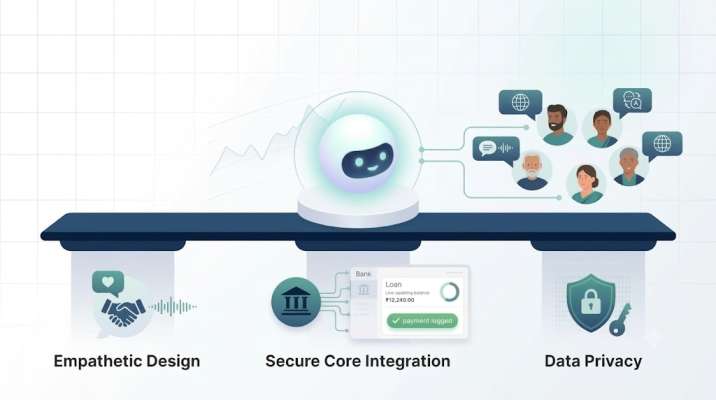
Deploying an AI debt collection management framework requires balancing operational efficiency with borrower empathy. Successful enterprise rollouts adhere to clear operational standards:
- Empathetic Interaction Design: Train voice agents to maintain a neutral, supportive tone focused on resolution rather than pressure.
- Secure Core Integrations: Deep integration with core banking software and loan management systems ensures real-time updates to borrower account balances and instant payment logging.
- Data Privacy & Regulatory Standards: All voice and transaction data processed through AI infrastructure must meet enterprise security standards, incorporating encryption in transit and at rest, strict access controls, and compliance with the DPDP Rules 2025.
For financial institutions operating across regional markets, multilingual conversational AI ensures seamless support for diverse borrower demographics in Hindi, Tamil, Telugu, Kannada, Marathi, Bengali, and English.
The Ello Advantage in Debt Collection Automation
Deploying a specialized enterprise voice AI platform lets banks, NBFCs, and digital lenders run high-volume recovery operations with precision. Ello’s voice AI agents are engineered specifically for enterprise recovery workflows, offering low-latency speech processing and multi-agent reasoning that handle complex borrower responses smoothly.
By automating early-stage EMI reminders and late-stage outreach, Ello connects with borrowers across regional languages and local accents with empathetic, compliant dialogue. By integrating deeply with existing core banking software, Ello syncs account balances, logs interactions automatically, and dispatches dynamic payment links during live calls.
Indian BFSI institutions that use voice AI for collections achieve higher recovery yields, lower roll rates into late-stage delinquency, and significantly lower operational expenses, making it one of the clearest wins for AI collections in India.
Frequently Asked Questions
1) What is AI debt collection?
AI debt collection uses conversational voice agents, natural language processing, and automated workflows to contact borrowers, verify identities, explain overdue balances, and automatically negotiate payment schedules.
2) How does voice AI handle difficult or angry borrowers?
Voice AI platforms use real-time sentiment detection to evaluate emotional tone and conversation context. If a borrower becomes overly frustrated or presents a complex dispute, the AI agent transfers the call to a human supervisor with full context.
3) Can AI debt collection systems integrate with existing loan management software?
Yes. Enterprise AI platforms connect to standard core banking applications, customer management systems, and payment gateways via web APIs to sync payment statuses and update records in real time.
4) Which languages do AI voice agents support for Indian BFSI?
Platforms like Ello support major Indian languages—including Hindi, Tamil, Telugu, Kannada, Marathi, Bengali, and English with regional Indian accents—allowing lenders to deliver localized, empathetic AI loan collection outreach across tier-2 and tier-3 markets.
Transform your recovery operations with intelligent, compliant, and empathetic voice automation. See how Ello helps financial institutions automate collections while improving borrower satisfaction. Book a demo of Ello’s enterprise voice AI platform.