
What Is an Auto Dialer and When Should an AI Voice Agent Take Over?
An auto dialer is software that automatically dials numbers from a contact list and routes answered calls to a live agent, a recorded message, or an automated workflow. An AI voice agent should take over when the conversation, rather than the dialing, becomes the bottleneck: routine scripted calls, language gaps, and tasks that need action mid-call.
On the campaign dashboard, Tuesday looked strong. The predictive dialer kept every agent busy, and the list moved quickly. On the other end of the line, it looked different. One customer picked up, heard silence, and hung up. Another waited while a rep searched for the account. A third answered in Telugu and reached an agent who spoke only Hindi and English.
That gap between dialing efficiency and conversation quality is where outbound programs stall. An auto dialer solves the first problem well; it was never designed for the second. Below, you will find how auto dialer software works, the main dialing modes and their trade-offs, where dialers hit their limits, six signals that an AI voice agent should take over, India’s rules for automated calls, and a pilot plan for choosing an AI voice agent platform.
What Is an Auto Dialer?
An auto dialer, also called an automatic dialer, is outbound calling software that places calls from a contact list without an agent keying in digits. It sorts live answers from voicemail, busy tones, and no-answers, and sends only live answers onward. Auto dialer software usually sits inside a contact center platform or connects to a CRM, so agents see the customer record as the call lands. By removing the time agents spend listening to rings, an outbound auto dialer became standard for collections, outbound sales calls, renewals, reminders, and surveys.
How an Auto Dialer Works, Step by Step
- The team loads a list with campaign rules: consent, calling windows, retry limits, and Do Not Disturb (DND) scrubbing.
- The dialer picks the next number based on its mode and pacing.
- It places the call and uses answering machine detection (AMD) to classify the outcome.
- A live answer goes to an agent, a recorded message, or an IVR flow.
- The system logs the outcome, schedules retries, and updates the CRM.
Types of Auto Dialers: Preview, Progressive, Power, and Predictive
Vendors define “power dialer” differently (one line per agent or a fixed ratio), so confirm it in any demo.
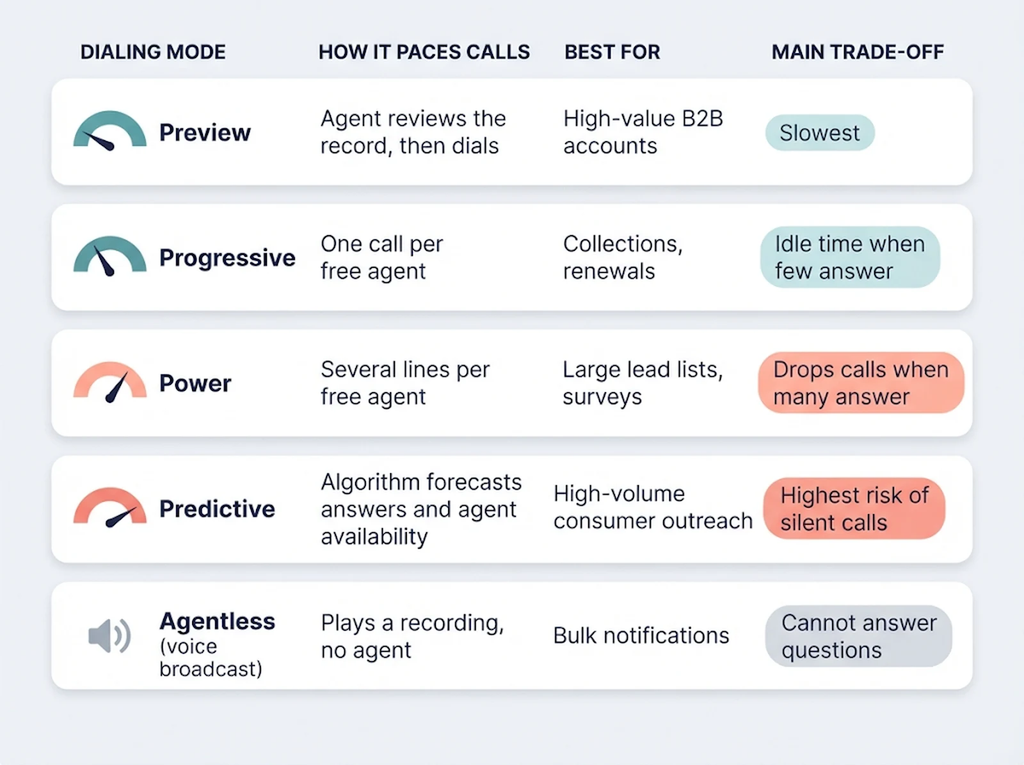
In short: the faster an auto dialer paces calls, the less control agents have, and the more answered calls risk being dropped.
Where an Auto Dialer for Call Centers Hits Its Limits
An auto dialer for call centers optimizes one thing: agent talk time. What happens after the customer says hello sits outside its job, and five limits appear as campaigns grow.
- Answered calls with nobody there: When more people pick up than agents are free, the customer hears silence, the abandoned call rate climbs, and customers learn to ignore the number.
- The agent ceiling: A dialer connects only as many live calls as there are agents on shift.
- Scripted talk consumes agent time: Identity checks and reminders fill calls that need no human judgment.
- Language mismatch: One Indian list can span Hindi, Telugu, Tamil, Bengali, and code-mixed speech, and splitting queues by language shrinks each agent pool. That is why multilingual voice AI in India has become a priority for outbound teams.
- No action during the call: Payment links, bookings, and record updates wait for after-call work, and some never happen.
Auto Dialer vs AI Voice Agent: What Changes After the Call Connects
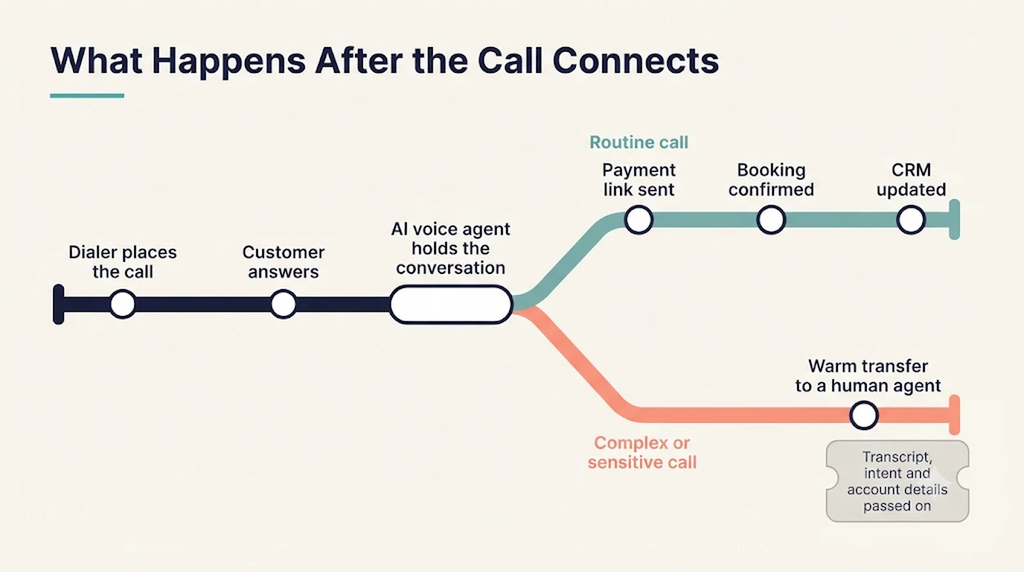
An AI voice agent handles the phone conversation: it listens, understands intent, answers questions, and completes tasks in connected systems. Teams new to what a voice AI agent actually does often assume it replaces the dialer, but it still needs a dialing layer. The difference is who speaks when the customer picks up.
Call Center KPIs: Auto Dialer Alone vs AI Voice Agent
| Call center KPI | Dialer with human agents | AI voice agent with human handoff |
|---|---|---|
| Contact rate | Capped by headcount and shifts | Every answered call handled at once |
| Abandoned call rate | Rises with aggressive pacing | No answered call waits for an agent |
| Average handle time (AHT) | Includes scripted steps and wrap-up | Routine calls finish end to end |
| Language coverage | Limited to each shift’s skills | Many languages and code-switching |
| Resolution per connected call | Varies with skill and fatigue | Consistent; complex cases go to people |
In short: an auto dialer improves how many calls connect, while an AI voice agent improves what each connected call achieves.
When Should an AI Voice Agent Take Over? Six Signals
The trigger is an operating pattern: the conversation, rather than the dialing, has become the constraint. These six signals show up in dialer reports and recordings.
1) Most Connected Time Goes to the Same Scripted Conversation
EMI reminders, appointment confirmations, KYC follow-ups, and renewal notices follow a short, predictable script that suits an AI voice agent. For this reason, early-stage automated collection calls are a common first deployment.
2) Abandoned Calls Rise Every Time You Push the Pacing
If supervisors keep lowering the predictive ratio to protect customers and raising it to hit targets, the floor has run out of agents, not leads.
3) Campaign Volume Outgrows Agent Headcount
Festive offers, renewal windows, and lead spikes arrive faster than hiring can follow. AI agents scale with volume and qualify leads on the first call, using conversational AI lead scoring to decide which prospects a sales rep should call back first.
4) Your List Speaks More Languages Than Your Floor
When “language barrier” dispositions cluster in certain states, the list has outgrown the floor. An AI voice agent that follows the customer’s language, including Hinglish, removes the routing problem.
5) The Call Needs a System Update Before It Ends
Payment links and reschedules should happen while the customer is listening, so AI outbound calling can complete the step in the CRM or payment system during the call.
6) Retries Need Memory of the Last Conversation
A dialer retries a number but forgets the customer asked for a call after salary day. AI voice agents carry context, so the next call starts where the last ended.
When the Human Agent Should Stay on the Call
Customers in distress, settlement negotiations, regulated advice, and anyone who asks for a human should reach a person. AI warm transfers pass the transcript, intent, and account details to the agent so the customer never repeats themselves.
Auto Dialer Rules in India: TRAI, A2P Calls, and DPDP
Any auto dialer running in India, and any AI voice agent, now operates under tighter telecom and data rules. This summary is not legal advice.
- Designated number series: TRAI’s February 2025 amendment stopped telemarketing from ordinary 10-digit numbers, keeping the 140 series for promotional calls and a new 1600 series for service and transactional calls.
- A2P calls must be declared: TRAI’s September 2026 amendment defines Application-to-Person (A2P) calls as calls started by software without direct human dialing, including autodialing, robocalls, and pre-recorded or artificial voice. Entities must pre-declare A2P use and their CLIs to the telecom provider, or the calls count as unsolicited commercial communication.
- Consent and inquiries: Promotional calls must respect DND preferences. Legacy consents count only when verifiable and registered with the telecom provider, and a customer’s written or digital inquiry permits calls for seven days.
- Data protection: Under the DPDP Rules notified in November 2025, the enterprise stays accountable for call recordings and transcripts as a data fiduciary. Map these duties early against the rules for voice AI compliance in India.
How to Pilot an AI Voice Agent Alongside Your Auto Dialer
Auto dialer best practices still apply after AI joins the stack: clean lists, scrubbed numbers, and tested scripts. Run the switch as a staged pilot.
- Pick one campaign: Choose a high-volume, scripted one, such as payment reminders.
- Record a baseline: Contact rate, right-party contact (RPC) rate, abandoned call rate, AHT, and conversion.
- Map the conversation: Main path, objections, and escalation rules.
- Connect the systems: CRM, payment gateway, and scheduling tools.
- Clear compliance: Declare A2P use and CLIs, scrub DND, store consent, and decide how calls disclose automation.
- Split the list: Half through the existing dialer, half through the AI voice agent, for a few weeks.
- Review and expand: Read transcripts weekly and expand once the AI side beats the baseline.
After a few pilots, floors get redesigned around the results, and an AI call center takes shape: people own the exceptions, and AI owns the routine.
Where Outbound Dialing Is Heading: Dialers That Hold the Conversation
- The AI auto dialer becomes the default layer: Dialing, conversation, and task completion are merging, and buyers will compare outcomes per connected call.
- Agentic resolution moves outbound: Gartner’s March 2025 forecast expects agentic AI to resolve 80% of common customer service issues without human intervention by 2029, with a 30% cut in operational costs.
- Number reputation becomes a metric: TRAI now has telecom providers flag suspected spam senders with AI/ML systems, so volume-first dialing puts CLIs at risk.
On outbound floors, the debate over whether AI will replace call center agents has a practical answer: people spend less time repeating scripts and more time negotiating, saving accounts, and closing complex sales.
The Ello Advantage: Outbound Calls That Finish the Job
Ello is an enterprise-grade AI voice agent platform built for where an auto dialer stops: the conversation after the customer answers. It completes the task on the line and hands complex calls to your team with full context.
- Adaptive Prompting Engine: dynamic, non-scripted dialogue, handles interruptions, reads sentiment and urgency in real time.
- Voice-to-Action Engine: completes tasks in CRMs, ERPs, ATS, and PMS platforms while the caller is still on the line, through 40+ integrations including Salesforce, HubSpot, Slack, and Zapier.
- Multilingual Vernacular Native: native support for 100+ languages with accent adaptation, including code-switching common on Indian calls.
- Self-Evolving Architecture: studies call outcomes and rewrites its own prompts, with guardrails, compliance checks, and audit trails on every change.
- Multi-Agent Quality Control: specialized AI agents audit and improve each other’s performance.
- Speed and Reliability: sub-500ms response latency and a 99.99% uptime SLA; powers 50,000+ calls daily.
- Enterprise Security Standards: SOC 2 Type II attested, with encryption, hallucination guardrails, and automated checks for TRAI DND registrations and calling-hour rules that help enterprises meet their regulatory duties.
Collections, renewals, and lead follow-up are common starting points for automated calling AI, because the scripts are clear and results show quickly.
Hear how an outbound campaign sounds when every answered call gets a real conversation, in English, Hindi, and regional languages: Book an Ello voice AI demo.
Frequently Asked Questions
1) What is the difference between an auto dialer and a predictive dialer?
An auto dialer is the broad category of software that places outbound calls automatically. A predictive dialer is one type that forecasts answer rates and agent availability, then dials several numbers at once. It delivers the most talk time but the highest risk of dropped calls.
2) Can an AI voice agent replace an auto dialer completely?
Not entirely. An AI voice agent still needs a dialing and telephony layer, but it can replace the human-agent model behind it for routine campaigns. Most enterprises run a hybrid model, where AI handles scripted tasks, and people take complex calls through a warm transfer.
3) Is using an auto dialer legal in India?
Yes, as long as it follows TRAI’s rules. Promotional calls use the 140 series and respect DND preferences, service calls use the 1600 series, and autodialed or artificial-voice (A2P) calls must be declared to the telecom provider. Call data also falls under the DPDP Act.
4) What should call centers look for in auto dialer software?
Look for multiple dialing modes, answering machine detection, DND scrubbing, CRM integration, and real-time monitoring. For an AI auto dialer, also check live-call latency, Indian language coverage, task completion during calls, context-aware handoff, and a SOC 2 Type II report.
5) Can a power dialer or predictive dialer handle Hindi and regional languages?
The dialer itself is language-neutral; coverage depends on the agents who answer, so multilingual campaigns need separate queues. An AI voice agent can follow the customer’s language, including code-mixed Hinglish, without routing to another team.
Conclusion
An auto dialer remains the most efficient way to get customers on the line, and for research-based sales, a preview dialer with a skilled rep still earns its place. The limit sits after the connection: silent calls, scripted conversations, language gaps, and tasks that wait for wrap-up. That is where an AI voice agent should take over.
Start with one scripted campaign, measure it against your auto dialer baseline, and expand where the numbers hold. Teams that move first will spend less on dialing and more on conversations that close.