
AI Phone Agent vs. Human Agent: When to Automate and Escalate
Rising average handle times, ballooning contact center operating costs, and persistent turnover among customer support representatives present severe challenges for modern enterprises. Contact centers face an unsustainable balancing act: delivering fast, consistent service while keeping staffing costs under control. Traditional telephony models force organizations to choose between inflated staffing budgets and degraded service quality, leading to long hold times and abandoned calls during volume spikes.
Deploying an autonomous AI phone agent shifts this operational dynamic by creating a hybrid workforce where digital and human capabilities reinforce one another. An automated AI phone agent handles transactional, high-volume inquiries in real time, freeing human representatives to focus primarily on high-stakes, emotionally complex interactions. This division of labor requires clear rules for when an automated phone agent should resolve an inbound request independently and when the call must escalate to a human specialist.
The Operational Limits of Traditional Contact Center Staffing
Relying entirely on human representatives for routine call volume generates structural friction across enterprise operations. Human agents bring empathy, complex negotiation, and creative problem-solving. However, forcing human specialists to spend hours performing repetitive data entry, identity verification, and routine status checks creates distinct operational failures.
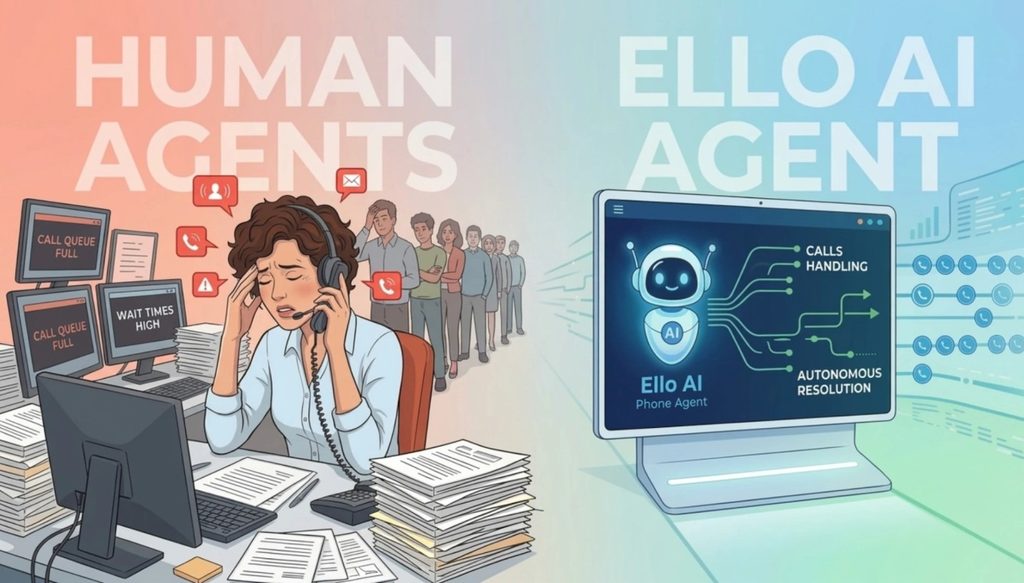
First, agent burnout accelerates when specialists spend their shifts answering repetitive administrative questions. High attrition rates force enterprises into perpetual recruitment and onboarding cycles, elevating overall cost per call. Second, human capacity cannot scale elastically to meet sudden volume surges. Unpredictable call spikes create long hold queues, driving up abandonment rates and souring customer relationships. Third, manual data capture during live calls introduces human error into customer management platforms, creating downstream inaccuracies in client records.
Deploying a voice AI assistant addresses these volume bottlenecks by providing instantaneous, instantly scalable handling for tier-one interactions. Contact center leaders looking to modernize their infrastructure often evaluate voice AI automation platforms to streamline routine call paths without expanding headcount.
Defining the High-ROI Automation Boundaries for an AI Phone Agent
An AI phone agent delivers maximum financial and operational value when assigned structured, predictable, and data-intensive telephone workflows. Modern voice AI platforms can query databases, execute API calls, and resolve customer requests in natural language without human intervention.
1. High-Volume Transactional Inquiries
Routine requests such as balance checks, payment processing, appointment scheduling, and order tracking are ideal for an AI calling agent. These workflows follow deterministic paths with structured outcomes that an automated system handles in seconds.
2. Identity Verification and Account Authentication
Initial call routing often wastes human representative time on security protocols. An automated phone agent handles secure caller verification, multi-factor authentication checks, and demographic validation before either resolving the query or transferring the authenticated session to a specialist.
3. Outbound Reminders and Collection Workflows
High-volume outbound communication demands consistent execution without administrative overhead. Automated systems handle proactive call campaigns for payment reminders, appointment confirmations, and service alerts. For regional financial institutions, targeted loan-collection voice agents automate routine payment notifications while maintaining regulatory compliance.
4. Dynamic Lead Qualification and Routing
Inbound marketing and sales calls require immediate response to preserve conversion rates. An AI phone assistant screens initial leads, evaluates purchase intent against preset scoring criteria, and updates CRM records immediately. Exploring broader outbound call automation demonstrates how automated outreach accelerates sales pipeline velocity.
By automating these structured tasks, contact centers eliminate routine queues and lower handle costs across every department.
Strategic Escalation: When to Transfer Calls to Human Specialists
Automation strategy requires clear protocols for transitioning a live interaction from an AI phone agent to a human specialist. Over-automating delicate or high-value calls harms brand trust, whereas under-automating routine calls wastes operational budget. Strategic escalation criteria ensure smooth handoffs based on intent, sentiment, and complexity.
1. High Emotional Intensity and Escalated Sentiment
When a caller exhibits severe distress, frustration, or anger, human empathy becomes essential. Modern speech analysis engines detect changes in tone, pitch, and speech cadence in real time. If caller sentiment crosses defined thresholds, the system immediately transfers the call to a senior representative.
2. High-Value Commercial and Negotiation Scenarios
Complex contract negotiations, enterprise sales calls, and high-dollar account retention risks require human intuition and flexible decision-making. While an AI calling agent efficiently qualifies early interest, closing high-value accounts benefits from an experienced sales executive’s contextual adaptability.
3. Non-Standard Edge Cases and Unstructured Problems
When an inquiry falls outside standard operational guidelines or requires cross-departmental policy exceptions, it requires human judgment. The AI system recognizes intent ambiguity, gathers initial context, and hands off the structured context file to a human agent without asking the caller to repeat information.
4. Explicit Customer Request for Human Support
Forcing customers through rigid automation loops damages satisfaction scores. If a caller explicitly requests human assistance, the AI phone agent should execute a prompt, courteous transfer while passing full conversational transcripts to the receiving representative’s screen.
Enterprise teams evaluating escalation architectures can review how modern call center AI agents preserve full caller state during live transfers to keep average handle times low.
How the Escalation Flow Works
A well-designed escalation flow keeps routine calls with the AI from start to finish and brings in a person only when it matters. It runs in five steps:
- Answer and verify: The AI agent answers the call instantly and verifies the caller’s identity.
- Classify intent: The agent identifies what the caller needs, such as a balance check, a booking, or a dispute.
- Check for an escalation trigger: The agent watches for the four triggers above: distress or anger, a high-value deal, an out-of-policy request, or a request for a person. If no trigger fires, the AI resolves the call and updates the CRM.
- Try to recover once: If a trigger fires, the agent makes one attempt to resolve it, for example by clarifying the request or offering an alternative. If that works, the AI completes the call. Skip this step when the caller asks for a person or is in distress.
- Warm transfer: If recovery fails, the call moves to a human agent, who receives the transcript, verified identity, and sentiment before the transfer connects.
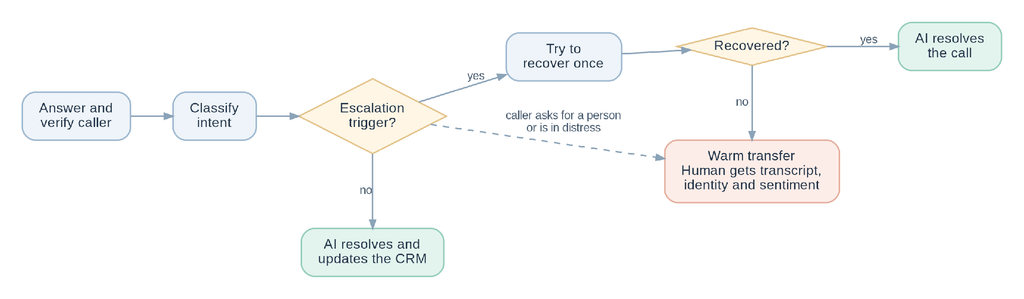
Routine calls stay with the AI end to end; a call reaches a person only after a trigger fires and one recovery attempt fails, unless the caller asks for a person outright.
Comparative Framework: AI Phone Agent vs. Human Agent
Evaluating the operational differences between digital and human voice coverage highlights how both roles complement one another in an enterprise contact center model.
- Response Latency: An AI phone agent answers inbound calls instantly and responds in under 500 milliseconds, eliminating hold times. Human agents depend on queue availability, creating variable wait times during high-volume periods.
- Operating Availability: An automated phone agent operates 24/7 without shift constraints or overtime premiums. Human agents work scheduled shifts requiring coverage plans for off-hours and holidays.
- Scalability: Digital voice infrastructure scales capacity dynamically from ten to ten thousand concurrent calls without onboarding delays. Human team capacity is limited by physical headcount and staffing schedules.
- Contextual Empathy: Human agents excel at deep interpersonal connection, subtle emotional negotiation, and creative policy adaptation. An AI voice agent delivers polite, consistent, and accurate responses, but escalates nuanced emotional situations to human teammates.
- Data Logging Accuracy: Digital voice assistants write structured conversation transcripts, field updates, and diagnostic outcomes to internal databases automatically during the call. Human data capture relies on post-call manual entry, which introduces reporting variability.
Understanding these structural differences helps contact center leaders design balanced operational frameworks. To examine how enterprise teams optimize overall handling efficiency, read how contact center automation lowers handle times across combined human-AI workflows.
Strategic Integration: Building a Unified Hybrid Contact Center
Optimal performance requires treating an AI phone agent as a digital teammate, not a standalone replacement for human staff. A unified hybrid contact center connects digital automation with human expertise through shared data pipelines and real-time context handoffs.
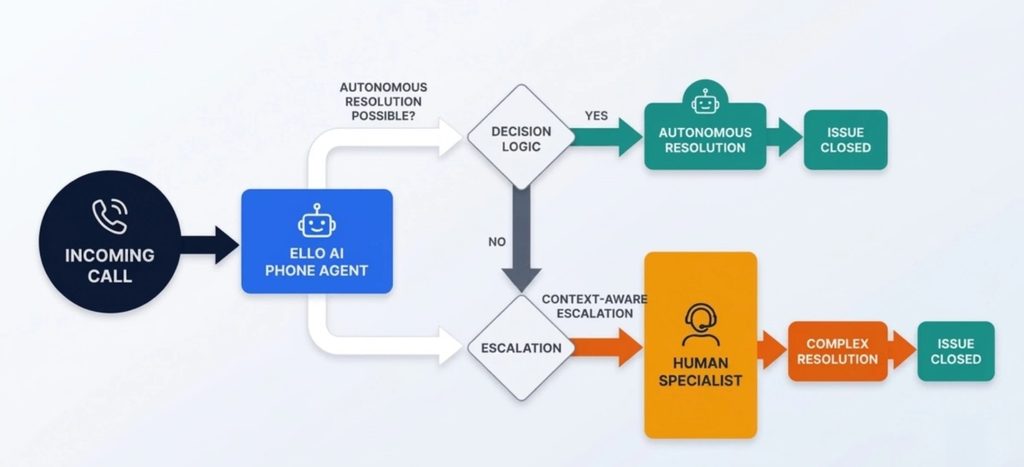
In this unified workflow, the automated system handles initial call reception, identity verification, and intent classification. When the query falls within routine parameters, the digital agent resolves the transaction and updates database records directly. When the call requires escalation, the AI phone assistant passes the complete caller transcript, verified identity, and sentiment profile directly to the human agent’s desktop interface.
Measuring Escalation Performance
Five metrics show whether the AI is resolving the right calls and handing off the rest smoothly:
| Metric | What it shows | How to calculate |
|---|---|---|
| Containment rate | Share of calls the AI resolves end to end | AI-resolved calls ÷ total calls × 100 |
| Transfer (handoff) rate | Share of calls escalated to a person | Escalated calls ÷ total calls × 100 |
| CSAT after transfer | Whether handoffs feel smooth to callers | Post-call survey on transferred calls only |
| First-call resolution | Whether the issue was solved without a callback | Calls resolved on first contact ÷ total calls × 100 |
| Repeat-information rate | Whether context really carried over | Transferred calls where the caller repeated details ÷ transfers |
The Ello Advantage: High-Performance Enterprise Voice AI
An effective human-AI contact center strategy requires an enterprise-grade platform with low-latency execution, multi-agent reasoning, and reliable system integration. Ello offers the technological foundation for enterprises scaling automated voice operations.
- Multi-Agent Cognitive Orchestration: Ello uses specialized agentic frameworks to reason through complex call logic, manage unexpected caller interruptions, and complete multi-step CRM actions in real time.
- Self-Evolving Learning Architecture: Ello continuously analyzes conversational transcripts. After processing initial call flows, the platform autonomously refines its prompt structures and operational dialogue paths, reducing average handle time (AHT) and boosting containment rates without manual developer intervention.
- Native Multilingual Capability: Built for global enterprise deployment, Ello natively supports 100+ languages and handles fluid code-switching and regional accents naturally, ensuring high task completion rates across diverse caller bases.
- Voice-to-Action Integration: Ello interfaces directly with enterprise CRMs, ERPs, and ticketing platforms via secure APIs, executing system actions in under 500 milliseconds while maintaining SOC 2 and HIPAA compliance and strict data privacy standards.
Frequently Asked Questions
1) What is an AI phone agent?
An AI phone agent is an autonomous voice software solution powered by conversational AI and speech synthesis that handles structured, high-volume phone calls, executes database actions, and seamlessly escalates complex or sensitive interactions to human agents.
2) How does an AI phone agent determine when to transfer a call to a human?
The system evaluates real-time signals, including caller sentiment intensity, intent complexity, explicit customer transfer requests, and predefined business-logic thresholds, to trigger a seamless transfer to a human specialist.
3) Can an automated phone agent handle callers with heavy regional accents or multiple languages?
Yes. Enterprise voice platforms such as Ello support 100+ languages and handle regional accents, colloquial phrasing, and live code-switching without losing context or execution accuracy.
4) What happens to customer data during an escalation transfer?
The digital agent compiles full caller session details—including verified identity, conversation transcript, intent profile, and sentiment context—and pushes this data directly to the human agent’s desktop interface before the transfer connects.
5) How does deploying an AI calling agent impact overall contact center costs?
Automating tier-one call volume reduces average handle time, eliminates off-hours staffing premiums, and significantly lowers cost per call while letting human agents focus on high-value retention and sales.
6) Will customers know they are talking to an AI?
They should. Modern AI phone agents sound natural, but best practice is to tell callers at the start of the call that they are speaking with an AI, and regulations in many regions require this disclosure. Callers should also be able to ask for a person at any point.
Modernize Your Contact Center Operations
Creating an efficient contact center requires balancing digital speed with human empathy. Deploying an AI phone agent to resolve structured, high-volume transactions lets human representatives focus on higher-value service where personal connection matters most.
Discover how Ello’s autonomous voice architecture transforms enterprise contact center performance by visiting the Ello AI Platform.