
First Call Resolution (FCR): Formula, Benchmarks, and 7 Fixes for Support Teams
First call resolution (FCR) measures whether a customer’s issue is fixed on the first contact, with no repeat call, callback, or reopened ticket. To calculate it, divide issues resolved on first contact by total eligible issues and multiply by 100. For most support teams, it is the one metric that moves cost and customer satisfaction together.
Think about the last time you called a bank or a telecom provider twice about the same problem. The first agent was polite, and the call was short, yet nothing got fixed: the refund needed approval, the request went to the wrong team, or the promised update never reached the system. On the dashboard, that first call looked efficient. To you, it was wasted time.
Repeat calls like these are easy to miss and expensive to carry. Below, you will find how to calculate first call resolution three ways, the latest FCR benchmarks by industry and call type, seven fixes that remove the causes of repeat calls, a 90-day plan to raise your first call resolution rate, and what changes when AI voice agents take the first call.
Key Takeaways
- First call resolution measures whether the customer’s issue was fixed on the first contact, not whether the call was short.
- The FCR formula is simple; the definitions of “resolved,” “first,” and the repeat-call window decide whether the number means anything.
- SQM Group’s latest benchmark puts the average at 69%, with only 5% of call centers reaching the 80% world-class mark, and complaints lowest at 48%.
- Each 1% gain in FCR adds about 1.4 points to interactional Net Promoter Score, according to SQM.
- Most repeat calls trace back to routing, missing authority or system access, stale knowledge, language gaps, and unfinished after-call work.
- AI voice agents raise first call resolution only when they complete the task during the call, not when they simply contain it.
What Is First Call Resolution?
First call resolution is a contact center metric that tracks the share of customer issues resolved completely during the first interaction. Many teams now call it first contact resolution, because the first touch may come through voice, chat, WhatsApp, or email rather than a phone call. The idea is the same: the customer asks once and does not have to come back.
FCR in call center operations is a balanced metric: a short call that leaves the problem open looks good on average handle time (AHT) and bad on first call resolution. The same logic applies to automation: judge AI agents for call centers on issues closed, not calls deflected.
First Call Resolution vs Other Call Center KPIs
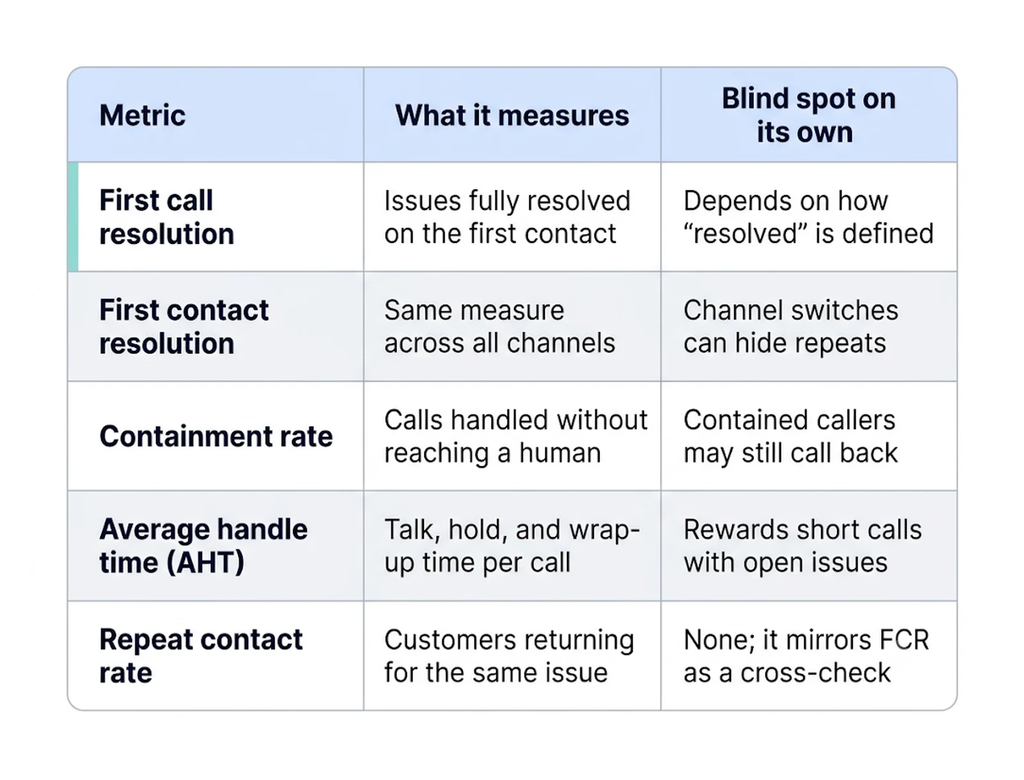
In short: first call resolution confirms the issue was actually fixed, while containment and average handle time can look good even when customers call back.
Why First Call Resolution in Call Centers Matters to Support Teams
SQM Group benchmarks more than 500 North American call centers each year using post-call customer surveys. Its 2025 FCR benchmark report shows why the metric deserves board-level attention:
- Operating cost: each 1% improvement in FCR saves a typical midsize call center about US$286,000 a year.
- Customer loyalty: each 1% gain in FCR adds about 1.4 points to interactional Net Promoter Score, and 95% of customers whose issue is resolved keep doing business with the company.
- Where repeats start: 49% of unresolved calls trace to the organization’s policies, tools, or processes, 38% to agents, and 13% to customers.
- Capacity: every repeat call removed frees an agent for a new customer during festive-season peaks and billing cycles.
Agents who can actually fix problems also face fewer angry second calls, which reduces burnout. Teams working on cost should pair FCR work with how contact center automation reduces handle time, since the two levers compound.
The FCR Formula: How to Calculate First Call Resolution
The FCR formula is:
First call resolution rate = (issues resolved on first contact ÷ total eligible issues) × 100
Example: A team handles 40,000 eligible calls in a month, and 11,200 of those customers call again about the same issue within seven days. That leaves 28,800 issues resolved on first contact, so the first call resolution rate is 28,800 ÷ 40,000 × 100 = 72%.
“Eligible” matters. Most teams exclude wrong numbers, silent calls, and spam. Whatever you exclude, document it and keep it fixed.
Three Ways to Measure First Call Resolution
| Method | How it works | Strength | Blind spot |
|---|---|---|---|
| Customer survey | Ask callers within a day if the issue was resolved | Customer’s view; how SQM benchmarks | Low response rates |
| Repeat-call analysis | Match customer ID for repeat contacts in a fixed window | Covers every call | Misses customers who give up |
| Agent disposition | Agent marks the case resolved at call end | Easy to collect | Overstates resolution under pressure |
The strongest programs combine repeat-call analysis with a survey sample and treat agent dispositions as a supporting signal.
Measurement Rules That Keep the Number Honest
- Repeat window: use one window, often 24 to 72 hours for simple requests and up to seven days for billing issues.
- Transfers: decide in advance whether a call resolved after an internal transfer counts as first contact resolution.
- Channel switches: a chat followed by a call about the same issue is a repeat contact, so match on customer ID.
- AI-handled calls: count them as resolved only if the customer does not return. Containment is not resolution.
- Customer confirmation: mark issues resolved only when the customer agrees, and track reopen rates.
FCR Benchmarks by Industry and Call Type
SQM Group’s 2024 benchmark of more than 500 North American call centers, published in February 2025, puts the average at 69%, with individual centers ranging from 43% to 88%. SQM rates 70% to 79% as good and 80% or higher as world-class, a level only 5% of call centers reach. Compare these figures with a survey or repeat-call measure of your own, not agent dispositions.
| Industry group | FCR (SQM, published 2025) |
|---|---|
| Retail, not-for-profit, insurance | 73% to 75% |
| Energy, health insurance, financial services | Lower end of 70% to 79% |
| Technical support, government, telecom | Below 70% |
Call type often matters more than industry.
| Call type | FCR (SQM, published 2025) |
|---|---|
| General inquiries | 73% |
| Account maintenance | 72% |
| Orders | 71% |
| Billing | 69% |
| Claims | 61% |
| Technical support | 60% |
| Complaints | 48% |
SQM’s research covers North American centers, so Indian teams should treat these FCR benchmarks as a reference point. The more useful comparison is each call reason against its own baseline: a lender at 55% on EMI queries and 80% on balance inquiries has a problem in one queue, not everywhere.
7 Fixes to Improve First Call Resolution
These first call resolution best practices are ordered by how quickly they pay back, starting with diagnosis and ending with transfers.
1. Find the Top Repeat-Contact Reasons First
Tag the reason for every repeat contact over the last 60 to 90 days, and track the repeat contact rate by reason. A handful of intents usually drive most repeats, and fixing the top five moves first call resolution further than broad training.
2. Route on Intent, Not Menu Digits
Callers who press the wrong IVR option reach an agent who cannot help, and the transfer often ends in a second call. Routing by stated intent sends them to the right team the first time, a major reason enterprises are retiring legacy IVR systems.
3. Give Agents the Authority and System Access to Finish the Job
Many repeat calls happen because the first agent could only log a request. Raise refund and waiver limits where risk allows, and give agents write access across CRM, billing, and ticketing so “let me check with the back office” disappears.
4. Fix Knowledge at the Point of the Call
Outdated knowledge sends agents to guess, escalate, or promise a callback. Assign owners to the articles behind your top call reasons, review them monthly, and surface them on screen during the call. The same discipline underpins helpdesk automation in enterprise support.
5. Serve Callers in the Language They Actually Speak
Indian callers mix Hindi, English, Tamil, or Telugu in one sentence. When the request is misread, the call ends without a fix. Route by language and support code-switching on automated lines; the case for multilingual voice AI in India rests largely on this repeat-call problem.
6. Complete the After-Call Work During the Call
A promised address change or refund that never gets entered generates a repeat call days later. Update the record, raise the ticket, and send the confirmation while the customer is still on the line. This is where agentic voice AI differs from older bots, because it can act inside business systems rather than only answer questions.
7. Make Every Transfer a Warm Transfer
A cold transfer forces the customer to repeat everything. A warm transfer passes identity, intent, and what’s been tried so the receiving expert can resolve the issue in the same call. When an AI agent takes the first call, the same rule applies: AI warm transfers pass the full conversation to the person who picks up.
A 90-Day Plan to Raise Your First Call Resolution Rate
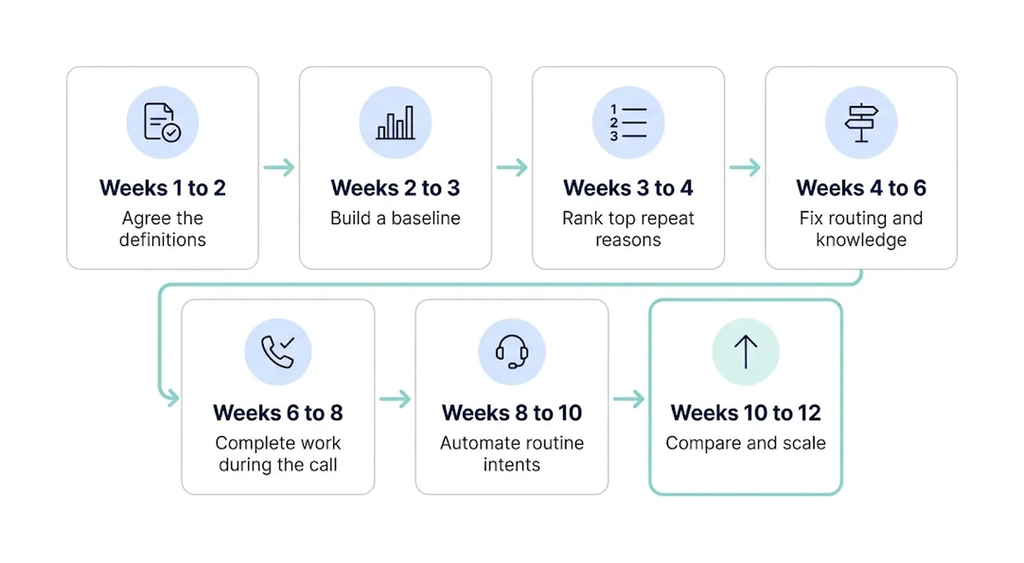
- Weeks 1 to 2: Agree on the definitions of resolved, eligible, and the repeat window.
- Weeks 2 to 3: Build a baseline first call resolution rate by call reason, language, and queue.
- Weeks 3 to 4: Rank the top five repeat-contact reasons and give each an owner.
- Weeks 4 to 6: Fix routing and knowledge for those reasons and raise agent authority limits.
- Weeks 6 to 8: Move after-call work into the call for the highest-volume intents.
- Weeks 8 to 10: Automate one or two routine intents, measured on resolution, not containment. Start with simple, high-volume calls such as order status or address changes, where voice-based conversational AI can finish the task without a handoff.
- Weeks 10 to 12: Compare FCR, repeat contacts, and customer satisfaction with the baseline, then scale what worked.
Where First Call Resolution Is Heading: Resolution by AI Agents
- AI agents resolving routine issues end to end: Gartner’s March 2025 forecast predicts agentic AI will autonomously resolve 80% of common customer service issues without human help by 2029, reducing operational costs by 30%.
- One metric across AI and human agents: AI first call resolution will be measured across the full journey, so an AI call followed by a human callback counts as one unresolved contact, not two separate wins.
- Recordings under stricter data rules: analyzing call recordings involves personal data, so consent, retention, and access controls must align with India’s Digital Personal Data Protection (DPDP) Act, with most data-fiduciary duties enforceable from May 2027.
For agents, the shift is in what fills their day: complaints, claims, and judgment calls that need experience. That is a more useful lens than asking whether AI will replace call center agents.
The Ello Advantage: Resolving More Calls on the First Attempt
Ello is an enterprise-grade AI voice agent platform built to resolve calls, not just answer them: it understands callers in their own language, completes the task during the call, and learns from every outcome.
- Adaptive Prompting Engine: dynamic, non-scripted dialogue; handles interruptions, reads sentiment and urgency in real time.
- Voice-to-Action Engine: completes tasks in CRMs, ERPs, ATS, and PMS platforms while the caller is still on the line, through 40+ integrations including Salesforce, HubSpot, Slack, and Zapier.
- Multilingual Vernacular Native: native support for 100+ languages with accent adaptation, including code-switching common on Indian calls.
- Self-Evolving Architecture: studies call outcomes and rewrites its own prompts, with guardrails, compliance checks, and audit trails on every change.
- Multi-Agent Quality Control: specialized AI agents audit and improve each other’s performance.
- Speed and Reliability: sub-500ms response latency and a 99.99% uptime SLA; powers 50,000+ calls daily.
- Enterprise Security Standards: SOC 2 Type II attested, with encryption, hallucination guardrails, and automated checks for TRAI DND registrations and calling-hour rules that help enterprises meet their regulatory duties.
Real-time call monitoring and custom reporting dashboards let teams track resolution by intent and language, and low AI voice agent latency keeps callers on the line until the issue is fixed.
See how Ello resolves routine support calls in English, Hindi, and regional languages: Book an Ello voice AI demo.
Frequently Asked Questions
1) What is a good first call resolution rate?
A first call resolution rate of 70% to 79% is good, and 80% or higher is world-class, a level only 5% of call centers reach in SQM Group’s latest benchmark, where the average is 69%. Compare each call type against its own baseline, because complaints and claims resolve on first contact far less often than inquiries or orders.
2) What is the difference between first call resolution and first contact resolution?
They measure the same outcome: an issue fully resolved on the first interaction. First call resolution began as a voice metric, while first contact resolution covers every channel, including chat, email, and WhatsApp. Most enterprises now use first contact resolution, so a chat followed by a call counts as a repeat.
3) How do you calculate first call resolution when a call is transferred?
Decide the rule in advance and apply it consistently. Most teams count a transferred call as resolved on first contact if the customer gets a complete fix on that same call and doesn’t return within the repeat window. A transfer that ends in a callback or second call counts as unresolved.
4) Can AI voice agents improve first call resolution for Hindi and regional-language callers?
Yes. FCR with AI voice agents rises when they understand code-switched speech and can complete the task during the call. Many repeat calls on Indian support lines come from misunderstood requests and unfinished follow-ups, and an agent that handles mixed Hindi and English and updates the CRM live removes both causes.
5) How does first call resolution affect contact center costs?
Higher first call resolution lowers costs because resolving an issue once prevents a repeat call. SQM Group estimates that each 1% improvement in FCR saves a typical midsize call center about US$286,000 a year, and it also lifts Net Promoter Score. Fewer repeat calls free agent capacity for new customers.
Conclusion
First call resolution is the clearest test of whether a support operation fixes problems or just processes calls. Teams that define it carefully, measure it by call reason and language, and remove the causes of repeat contact outperform those chasing shorter calls.
The next gains come from closing the gap between understanding a request and completing it. Whether an empowered agent, an AI voice agent, or both in a warm handoff does the work, the goal is the same: the customer explains the issue once, and first call resolution becomes the normal outcome.