
How to Evaluate Conversation Intelligence for a High-Volume Contact Center
To evaluate conversation intelligence for a high-volume contact center, test each shortlisted tool on your own call audio against eight criteria: transcription accuracy, language coverage, call coverage at scale, real-time speed, insight quality, actions inside your systems, data compliance, and total cost. Then run a 30-day pilot on one live queue.
Most quality teams in large contact centers still score a handful of calls per agent each week by hand. At 50,000 calls a day, that leaves almost every complaint, compliance slip, and churn signal unheard. Conversation intelligence closes that gap by automatically analyzing every call.
The category is crowded, though, and many tools were built for 30-minute sales meetings recorded on video platforms. They struggle with short telephony calls, regional accents, mixed-language speech, and strict data rules.
This blog gives operations, CX, and IT leaders a practical framework for comparing conversation intelligence solutions at contact center scale, the questions to ask vendors, and a pilot plan that produces a defensible decision.
Key Takeaways
- Test every conversation intelligence tool on your own call audio.
- Confirm that sentiment and intent analytics work in every language you serve, including code-mixed calls.
- Require 100% call coverage at peak volume, with no sampling.
- Favor platforms that write results into your CRM and workflows instead of stopping at dashboards.
- Check DPDP readiness: redaction, consent and erasure support, and a signed data processing agreement.
- Make the final decision after a 30-day pilot on one live queue, scored against weighted criteria.
What Is Conversation Intelligence?
Conversation intelligence is software that records, transcribes, and analyzes customer conversations, then turns them into structured insights: caller intent, sentiment, compliance events, objections, and next actions. It relies on speech recognition, natural language processing, and machine learning. Teams also call it conversational intelligence, and vendors sell it as conversational intelligence software or AI conversation intelligence.
It helps to separate it from conversational AI. Conversational AI holds the conversation, the way a voice AI agent or chatbot does. Conversation intelligence listens to conversations, whether a person or an AI handled them, and explains what happened.
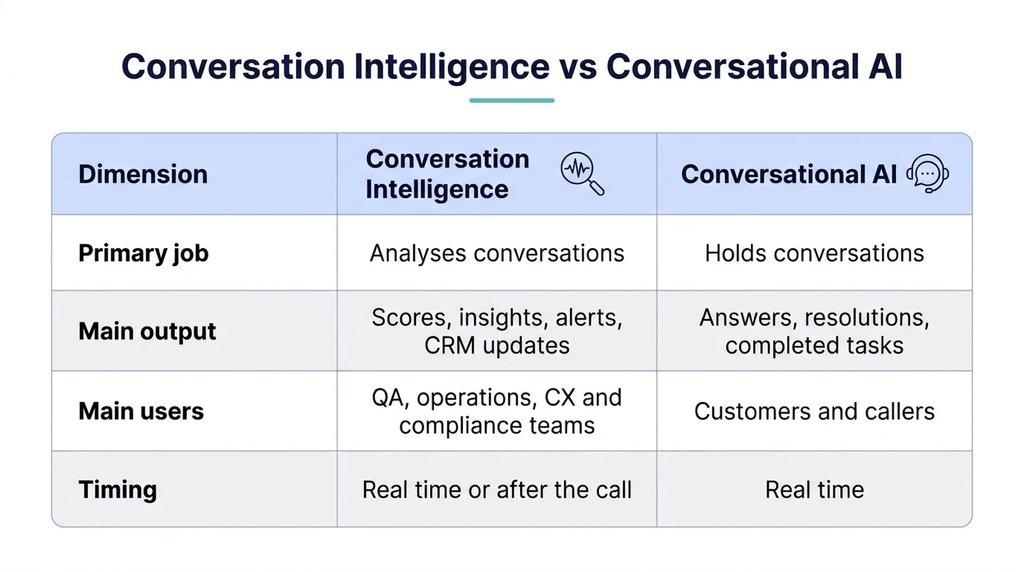
In short: conversation intelligence analyzes calls during or after they happen, while conversational AI runs the conversation itself.
What the Software Analyzes on Every Call
- Full Transcripts: Speaker-separated records, searchable across all calls.
- Caller Intent: Contact reasons, including new reasons nobody has tagged yet.
- Sentiment and Escalation Risk: Tracked through the call rather than only at the end.
- Compliance Events: Missing disclosures or payment data spoken aloud.
- Agent Behavior: Talk-to-listen ratio, silence, interruptions, and script adherence.
- Outcomes and Follow-Ups: Promises to pay, callbacks, and unresolved issues.
Why High-Volume Contact Centers Need a Different Evaluation
Most buying guides for conversation intelligence are written for sales teams reviewing recorded meetings. Contact centers buy under different pressures, and each one changes what you should test.
- Volume: Tens of thousands of short calls a day make cost per analyzed minute and processing speed matter more than per-seat features.
- Audio Quality: Narrowband telephony, background noise, and hold music push transcription accuracy well below vendor demo figures.
- Language Mix: Callers switch languages mid-sentence. In India, Hindi-English and Tamil-English code-mixing is normal on service lines.
- Regulation: Recordings hold personal and payment data, which India’s Digital Personal Data Protection (DPDP) Act and sector regulators govern.
- Labor Economics: Human agent labor is the highest cost in running a contact center, which makes it the first place AI delivers savings. Gartner’s March 2025 forecast predicts that by 2029, agentic AI will resolve 80% of common customer service issues without human intervention, cutting operational costs by 30%.
That last point sets the bar. Analysis pays off when it removes agent workload and rework, so judge each tool on the work it takes away. If you are also weighing AI agents for call centers, evaluate the two together, because in 2026 they increasingly share the same call data.
8 Criteria for Evaluating Conversation Intelligence Solutions
Score every conversation intelligence vendor against the same eight criteria, using your own recordings rather than demo audio.
1. Transcription Accuracy on Your Own Audio
Vendor accuracy figures usually come from clean, single-language recordings. Ask for word error rate measured on your calls, split by language, accent, and queue. Check how the model handles your domain terms, such as product names, policy numbers, and rupee amounts.
How to test: Run 300 or more of your calls through each tool and compare the output with human transcripts.
2. Language and Code-Switching Support
Many conversational intelligence software products transcribe Indian languages but run sentiment and intent models only in English. Ask whether each analytics feature works natively in every language you serve, and whether the models were trained on code-mixed speech. The case for multilingual voice AI in India applies equally to analytics: insight is only as good as the language understanding beneath it.
3. Coverage at Scale
Confirm the conversation intelligence platform analyzes 100% of calls at your peak hour, with no sampling. Ask how long post-call processing takes at peak, how pricing changes at your annual minute volume, and for a reference customer of similar size.
4. Real-Time Speed
Live agent prompts and supervisor alerts help only when they land within a second or two of the trigger. Ask for 95th percentile latency on live streams, measured under load. Our explainer on AI voice agent latency covers why response time shapes the caller’s experience.
5. Insight Quality and Explainability
Automated QA scores should map to your existing scorecard, and every score should link to the exact transcript moment that produced it. Check the false positive rate on compliance alerts, because supervisors stop trusting a tool that raises too many. Look for topic discovery that surfaces new contact reasons without manual tagging.
6. Action and Integration Depth
Insight that stays in a dashboard changes little. Check whether the platform writes summaries, dispositions, and follow-up tasks into your CRM and ticketing tools, triggers workflows, and feeds automation directly. This is where AI conversation intelligence produces measurable savings, as our analysis of how contact center automation reduces handle time shows.
7. Security, Privacy and Compliance
Conversation intelligence stores your most sensitive data, so ask for automatic redaction of card numbers, bank details, and ID numbers in both audio and transcripts. Confirm encryption in transit and at rest, role-based access, data residency options, and configurable retention. Request the vendor’s current SOC 2 report and confirm whether it is Type I or Type II (Type II tests how controls perform over time). For healthcare, also check its HIPAA controls.
In India, the DPDP Rules were notified in November 2025 with an 18-month phased rollout, so most duties for data fiduciaries apply from May 2027. Your enterprise stays accountable for that data, so confirm the vendor will sign a valid contract (a data processing agreement) and can support consent withdrawal and erasure requests.
8. Total Cost and Time to Value
Compare per-minute pricing, implementation fees, integration work, and the internal admin time each tool needs. Ask how soon the first usable insight arrives after go-live. If your team is tempted to build in-house, weigh it with our build vs buy framework for voice AI.
Vendor Scoring Table
| Criterion | What to test | Weight | Red flag |
|---|---|---|---|
| Transcription accuracy | Word error rate on 300+ of your calls, by language | 15% | Only demo-audio figures |
| Language support | Analytics in each language, code-mixed calls | 15% | English-only sentiment |
| Insight quality | Score traceability, false alert rate | 15% | Scores with no transcript evidence |
| Action and integration | CRM write-back, workflow triggers | 15% | Dashboard-only output |
| Coverage at scale | 100% of calls at peak, processing time | 10% | Sampling or overnight batches |
| Real-time speed | 95th percentile alert latency under load | 10% | No live-stream option |
| Security and compliance | Redaction, SOC 2 report type, DPA, residency | 10% | No redaction in audio |
| Cost and time to value | Cost per analyzed call, weeks to first insight | 10% | Opaque services fees |
Adjust the weights to your priorities. Regulated sectors such as banking and insurance often raise compliance to 20%.
Questions to Ask Conversation Intelligence Vendors
Use these questions in every vendor demo. A strong conversation intelligence vendor will answer each one with evidence from your own call data.
- What is your word error rate on our recordings, split by language, accent, and queue?
- Do your sentiment and intent models run natively in every language we serve, including code-mixed Hindi-English calls?
- Can you analyze 100% of our calls at peak volume, and how long does post-call processing take?
- What is your 95th percentile latency for live agent prompts and supervisor alerts under load?
- Does every automated QA score link to the exact transcript moment that produced it?
- Which CRM and ticketing tools can you write summaries and dispositions into, and can you trigger workflows directly?
- Do you redact card numbers, bank details, and ID numbers in the audio and the transcript?
- Can you share your current SOC 2 report, confirm whether it is Type I or Type II, and sign a data processing agreement with data stored in India?
- What is the all-in cost per analyzed call at our annual volume, including implementation and integration?
- Will you support a 30-day pilot on one of our live queues before we sign?
How to Run a 30-Day Conversation Intelligence Pilot
A structured pilot turns vendor claims into evidence. Run this checklist with QA, operations, IT security, and legal involved from day one.
- Pick three measurable outcomes, such as QA coverage, average handle time, first-contact resolution, or compliance breach rate, and record the current baseline.
- Pull a representative call sample that covers every language, queue, peak hour, and poor-quality line you handle.
- Have your QA team hand-label 300+ calls to create ground truth.
- Run every shortlisted vendor on the same sample and score each one with the table above.
- Connect one live queue and one integration, such as CRM write-back of call summaries.
- Track the three outcomes weekly against the baseline.
- Review redaction, access logs, and data flows with IT security and legal.
- Decide based on cost per analyzed call and projected annual impact.
Include an outbound queue if you run collections or sales calls. Their call patterns differ sharply from inbound service, and a tool tuned only for support calls will miss them.
Where Conversation Intelligence Is Heading: Analysis That Acts
The first generation of conversation intelligence told managers what went wrong last week.
The 2026 generation acts during the call. Three shifts stand out.
- Analysis and Conversation in One System: When the same platform answers calls and analyzes them, every finding can change the next conversation. This is why enterprises retiring legacy IVR systems now ask for analytics and voice automation together.
- Agentic Action: A modern conversational AI architecture links intent detection to task execution, so a detected objection or promise to pay updates the CRM before the call ends.
- Self-Improving Prompts: Platforms now study call outcomes and rewrite their own prompts, instead of waiting for quarterly script reviews. In automated collection calls, this lets scripts adapt to the objections callers actually raise.
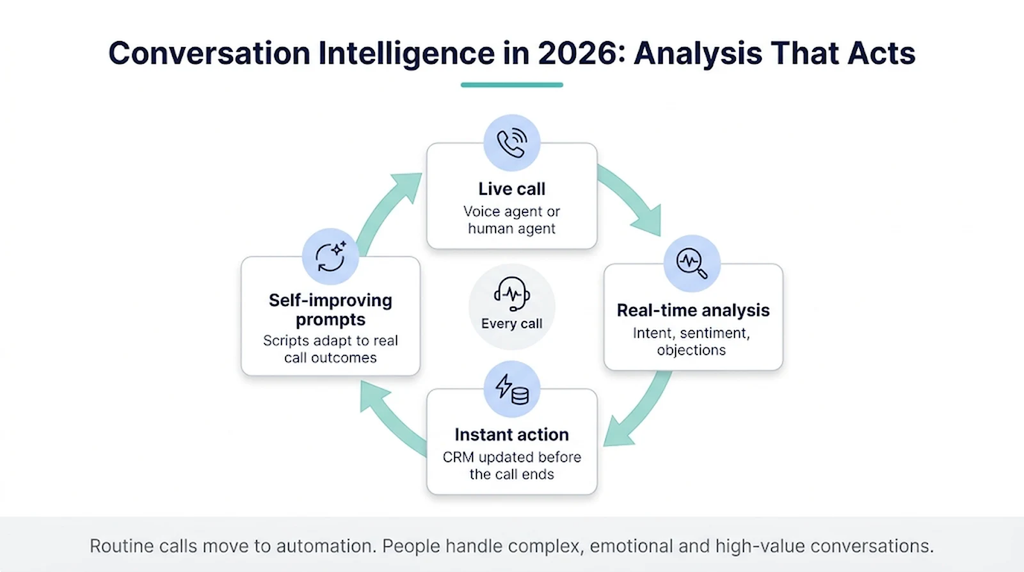
For human teams, the effect shifts where agents spend their time. Routine calls move to automation, and people handle complex, emotional, or high-value conversations, a question we examine in whether AI will replace call center agents.
The Ello Advantage: Conversation Intelligence That Acts on Every Call
Ello is an enterprise voice AI platform that places conversation intelligence inside the call itself. It powers more than 50,000 calls a day, and the same system that holds each conversation also analyzes it and acts on it:
- Adaptive Prompt Engine: Holds dynamic, non-scripted dialogue, handles interruptions, and reads caller sentiment and urgency in real time. Its self-evolving loop studies live call data and rewrites its own prompts, with guardrails, compliance checks, and audit trails on every change.
- Multi-Agent Quality Control: Specialized AI agents audit and improve each other’s performance, giving continuous QA across every call Ello handles.
- Voice-to-Action Engine: Completes tasks inside CRMs, ERPs, ATS, and PMS platforms while the caller is still on the line, through 40+ integrations including Salesforce, HubSpot, Slack, and Zapier.
- Real-Time Analytics: Live call monitoring, conversation analytics, and custom reporting dashboards.
- Multilingual Vernacular Native: Native support for 100+ languages with accent adaptation, including the colloquial code-switching common on Indian service lines.
- Speed and Reliability: Sub-500ms response latency and a 99.99% uptime SLA.
- Enterprise Security Standards: SOC 2 Type II attested and HIPAA compliant, with encryption, hallucination guardrails, and automated checks for TRAI DND registrations and calling-hour rules that help enterprises meet their regulatory duties.
If you are comparing vendors, our article on choosing an AI voice agent platform pairs well with the scoring table above.
See what that looks like on live calls in English, Hindi, and regional languages: Book an Ello voice AI demo.
Frequently Asked Questions
1) What is conversation intelligence in a contact center?
Conversation intelligence in a contact center is AI software that transcribes and analyzes every customer call to surface intent, sentiment, compliance risks, and agent performance. It replaces manual call sampling with full coverage and feeds its findings into QA, coaching, and CRM workflows.
2) How is conversation intelligence different from conversational AI?
Conversation intelligence analyzes conversations, while conversational AI holds them. A voice AI agent or chatbot is conversational AI, and the system that scores and explains those calls is conversation intelligence. In 2026, leading platforms combine both in one system.
3) What should high-volume contact centers look for in conversation intelligence solutions?
Prioritize transcription accuracy on your own audio, analytics in every language you serve, 100% call coverage, CRM write-back, and strong redaction. Test these in a 30-day pilot on real calls before you compare prices.
4) Does conversational intelligence software work for Hindi-English calls?
It depends on the vendor. Many tools transcribe Hindi-English speech but analyze sentiment and intent only in English. Ask for accuracy figures on code-mixed calls and test with your own recordings.
5) Is AI conversation intelligence compliant with India’s DPDP Act?
Compliance depends on how you deploy it, because your enterprise remains accountable as the data fiduciary. Choose a vendor that redacts personal data, supports consent and erasure requests, signs a data processing agreement, and offers data residency options.
6) What is the difference between conversation intelligence and speech analytics?
Speech analytics transcribes calls and scans them for keywords, sentiment, and compliance issues after the call ends. Conversation intelligence goes further: it works across voice, chat, and email, understands intent and context, and recommends next steps, often in real time. Speech analytics tells you what was said; conversation intelligence tells you what it means and what to do next.
Conclusion
The right conversation intelligence platform for a high-volume contact center hears every call accurately, in every language your customers speak, and turns what it hears into completed work. Contact centers that test on their own audio, weight action as heavily as analytics, and insist on compliance evidence will reduce QA effort, cut repeat contacts, and give agents time for the conversations that need a person.