
Build vs Buy: How Enterprises Should Evaluate In-House vs Platform Voice AI
Building a voice AI agent internally gives enterprises control over the technology stack. Using a voice AI platform can accelerate deployment while reducing the infrastructure and maintenance burden.
The decision becomes more complex once voice AI moves beyond a proof of concept. Production deployments require reliable telephony, speech processing, AI orchestration, enterprise integrations, workflow automation, security, monitoring, and scalability.
That makes the build vs buy AI voice agent decision less about whether an enterprise can build the technology and more about whether it makes business sense to own and operate the entire stack.
What Does It Really Take to Build a Voice AI Agent?
A production voice AI agent involves much more than connecting a language model to a phone number.
An enterprise needs to consider the entire technology stack, including:
- Voice and speech infrastructure
- AI and agent orchestration
- Telephony and enterprise integrations
- Security, monitoring, analytics, and scaling
The work continues after the initial deployment. Internal teams need to manage model updates, integration changes, performance optimization, security requirements, production issues, and increasing call volumes.
This is where in-house voice AI development becomes a long-term operating commitment rather than a one-time engineering project.
Before making a build vs buy AI voice agent decision, enterprises need to understand the full scope of what they would actually own.
Build vs Buy AI Voice Agent: Where the Trade-Offs Actually Sit
The choice becomes clearer when you evaluate the two approaches against the factors that matter in production.
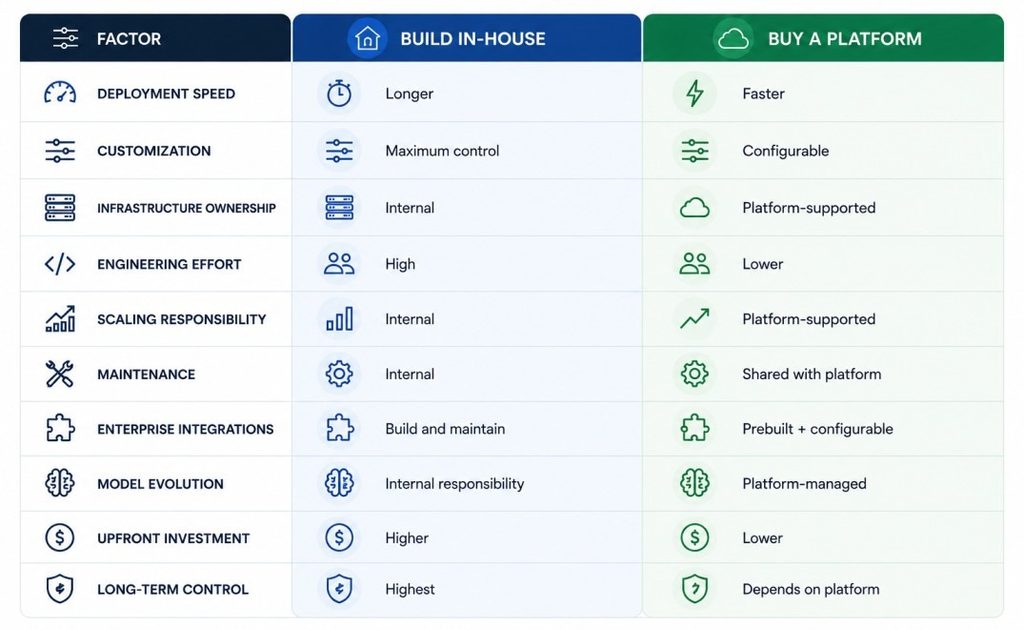
Neither approach is automatically right for every enterprise.
The important question is where the organization wants to invest its engineering resources and where voice AI creates genuine business differentiation.
Enterprise adoption patterns also show why platform-based approaches deserve consideration. Research found that 66% of enterprise IT leaders are building AI agents on enterprise AI infrastructure platforms, while 60% are using agentic capabilities embedded in existing core applications.
The decision is therefore becoming more nuanced than simply choosing between completely custom development and an off-the-shelf product.
The Hidden Cost of Building Voice AI In-House
Initial development is only one part of the cost of in-house voice AI development.
Beyond engineering salaries, enterprises may need to account for infrastructure, telephony, model usage, testing, integration maintenance, security, monitoring, scaling, model upgrades, and incident management.
There is also an opportunity cost. Engineering teams spending significant time maintaining voice infrastructure have less capacity for initiatives that directly differentiate the business.
A realistic build vs buy AI voice agent calculation should therefore consider total cost of ownership across the entire lifecycle.
The important question is: What will it cost to operate the system two or three years after launch?
That answer can look very different from the cost of building the first version.
When Should an Enterprise Build, Buy, or Choose Hybrid?
There is no universal answer. The right approach depends on what voice AI means to the organization.
Build makes sense when:
- Voice AI is part of the company’s core product.
- Highly specialized capabilities create competitive advantage.
- Existing platforms cannot meet critical requirements.
- The organization has the required AI and engineering expertise.
- The enterprise can support long-term maintenance and upgrades.
Buy makes sense when:
- Speed to production is important.
- Voice AI supports the business rather than being the core product.
- Multiple teams need voice automation.
- The organization wants less infrastructure ownership.
- Reliability and scalability are priorities.
Hybrid makes sense when:
- Proprietary workflows and business logic need to remain under internal control.
- Existing enterprise systems need to remain part of the architecture.
- The organization wants platform infrastructure without giving up customization.
For many enterprises, the hybrid model provides a practical balance between control and operational efficiency.
How to Evaluate a Voice AI Platform Before Buying
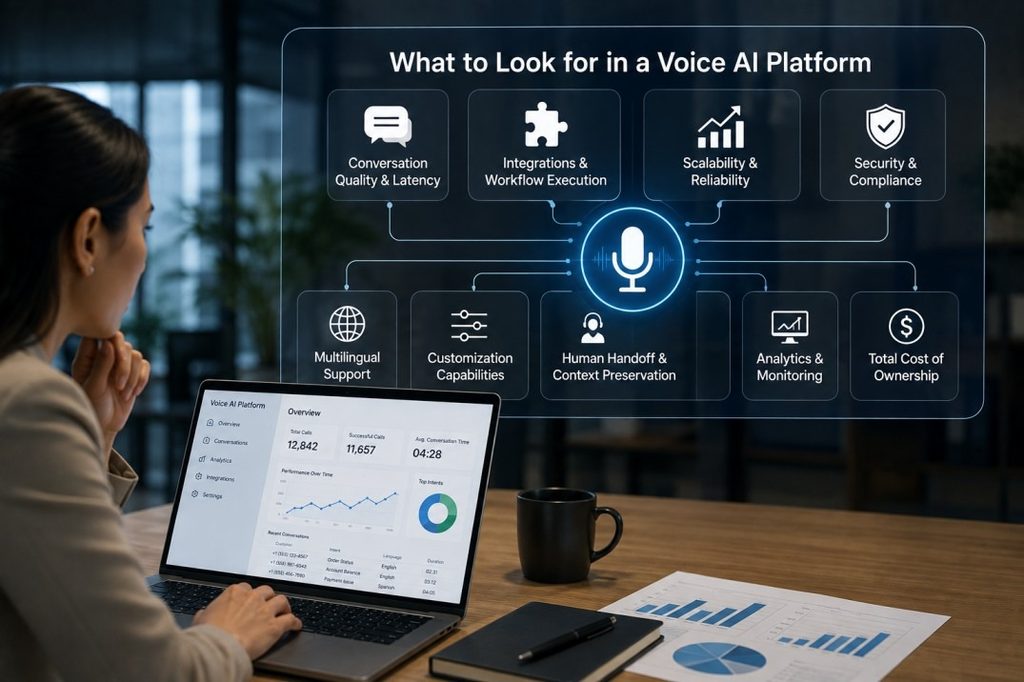
A strong voice AI platform evaluation should focus on how the technology performs in the environment where it will actually operate.
Conversation quality and latency determine whether interactions feel natural. Integrations and workflow execution determine whether the agent can actually complete business tasks instead of simply answering questions.
Enterprises should also examine:
- Scalability and reliability
- Security and compliance
- Language and multilingual support
- Customization capabilities
- Human handoff and context preservation
- Analytics and performance monitoring
- Total cost of ownership
A platform may look compelling during a demonstration but struggle with production call volumes or complex enterprise workflows. Testing with real use cases, integrations, languages, and expected traffic provides a much clearer picture.
The goal of voice AI platform evaluation is to determine whether the platform can support today’s requirements while remaining viable as automation expands.
How Ello Fits the Build vs Buy Decision
For enterprises that want customized voice AI experiences without taking responsibility for every layer of the underlying infrastructure, a platform approach can provide a practical path to production.
Ello combines conversational voice AI with enterprise integrations, workflow automation, multilingual capabilities, and human escalation. This allows organizations to focus internal resources on customer journeys, business logic, and differentiated workflows while the platform supports the underlying voice experience.
For a build vs buy AI voice agent decision, that distinction matters. Enterprises can retain control over the processes that make their customer experience unique without building and maintaining every component required to operate voice AI at scale.
Conclusion
The build vs buy AI voice agent decision should begin with business requirements rather than technology preference.
Building makes sense when voice AI itself creates strategic differentiation, and the organization has the resources to operate it long term. Buying makes sense when speed, scalability, reliability, and reduced infrastructure ownership matter more. A hybrid approach can provide control over proprietary workflows while reducing the burden of managing the underlying voice AI stack.
The right choice comes down to where the enterprise creates more value: building the infrastructure or applying voice AI to the customer experiences and workflows that differentiate the business.
FAQs
1) Is it better to build or buy an AI voice agent?
It depends on the enterprise’s requirements, resources, timeline, and long-term operating model.
2) How much does it cost to build a Voice AI agent?
Costs vary based on infrastructure, integrations, call volume, engineering resources, and ongoing maintenance.
3) When does in-house Voice AI development make sense?
It makes sense when Voice AI is strategically important or requires capabilities that existing platforms cannot provide.
4) What should enterprises consider when evaluating a Voice AI platform?
Evaluate conversation quality, integrations, scalability, security, latency, analytics, customization, and total cost.
5) Can enterprises combine in-house systems with a Voice AI platform?
Yes. A hybrid model lets enterprises retain control over proprietary workflows while using a platform for core Voice AI infrastructure.