
AI Voice Agents for Business and the ROI They Deliver
Escalating labor costs, high call center turnover, and inefficient call routing continue to erode margins across enterprise service organizations. Industry estimates put live human agent calls at $6.00 to $12.00 per contact. At the same time, traditional IVR menus often fail with complex or multi-step inquiries. Enterprises face a clear dilemma: adding headcount raises costs in step with call volume, while static self-service systems hurt customer experience scores. AI voice agents resolve this by replacing rigid decision trees with real-time voice workflows that handle routine and complex calls at a fraction of the cost of live agents.
Measuring the financial impact of voice technology means looking beyond simple call deflection. Today’s voice AI systems act as digital teammates that complete real backend actions during the call. Implementing AI voice agents lets organizations automate inbound customer support, outbound sales qualification, and routine collections, delivering quick efficiency gains. For leaders new to the technology, start by understanding what a voice AI agent is and how it delivers measurable ROI.
What ROI Do AI Voice Agents Deliver?
AI voice agents deliver ROI by handling routine calls at a fraction of the cost of live agents, removing manual after-call work, covering calls 24/7, and responding to new leads instantly. Most of the return comes from lower cost per contact and from scaling call capacity without adding headcount.
Key takeaways
• Automating routine calls lowers cost per contact far below live agent rates.
• AI agents log every call automatically, freeing agent time spent on after-call work.
• 24/7 coverage and instant lead response turn missed calls into revenue.
The Economic Drivers of Enterprise Voice AI Adoption
Enterprise leaders adopt voice automation mainly to fix rising costs and limits on how many calls their teams can handle. Traditional contact centers carry compounding costs across recruitment, onboarding, quality monitoring, and technology licensing.
Traditional Model: Inbound Call -> Human Agent Queue -> High Handle Time -> High Cost ($6–$12/call)
Modern Voice AI Model: Inbound Call -> Sub-500ms Voice Agent -> Real-Time API Execution -> Instant Resolution (<$1/call)
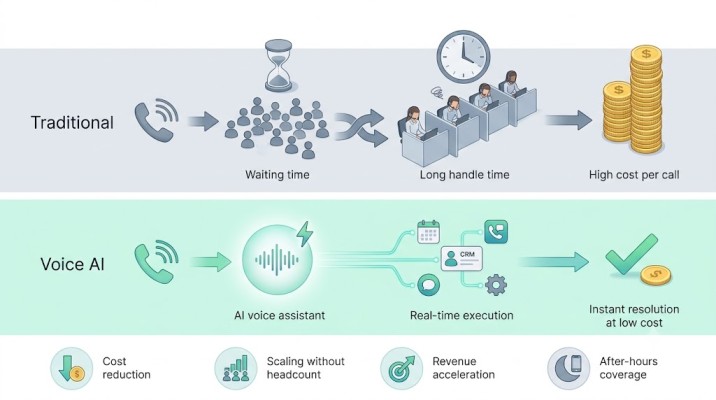
When evaluating voice AI for business, organizations target four core financial drivers:
- Direct Cost Reduction: AI voice agents process routine calls at a unit cost far below live agent interactions, lowering total cost per contact across high-volume queues.
- Scalability Without Headcount Growth: Voice AI scales instantly to handle sudden call spikes during peak seasons or promotional campaigns without requiring temporary staffing.
- Revenue Acceleration: Real-time lead qualification converts at higher rates than leads that wait for a manual callback.
- After-Hours Coverage: Automated phone systems capture inquiries 24 hours a day, preventing revenue loss from missed evening or weekend calls.
Moving from legacy infrastructure to a voice AI assistant for business lets organizations contain costs without sacrificing customer experience.
Measuring Enterprise AI Voice Agent ROI Across Core Metrics
The ROI of AI voice agents shows up in four measurable areas across customer service, sales, and back-office workflows:
1. Cost per Contact Reduction
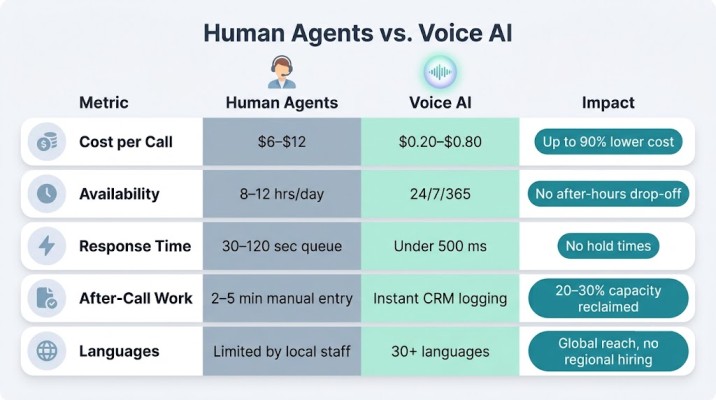
The most immediate ROI of AI voice agents is a sharp drop in cost per interaction. By automating high-frequency calls (such as balance inquiries, appointment confirmations, and order tracking), organizations shift volume away from expensive human channels. Contact center automation helps teams lower average handle times and operating costs.
2. Elimination of After-Call Work (ACW) Overhead
Human agents spend 20-30% of their shift on post-call administrative tasks, including writing interaction summaries, tagging intent categories, and updating CRM records. AI voice agents log structured call data automatically during and after the call, reclaiming thousands of agent hours each year.
3. Customer Lifetime Value and First-Contact Resolution
Legacy touch-tone IVR menus frustrate callers, leading to call abandonment and customer churn. Replacing static menus with conversational IVR improves first-contact resolution rates, protects recurring revenue, and improves customer retention.
4. Lead Conversion Velocity
In sales and lead generation, speed-to-lead drives conversion. Prospective buyers contacted within five minutes of an inquiry are significantly more likely to qualify than those called hours later. Voice AI for lead generation lets sales organizations contact, qualify, and route warm buyers to sales representatives immediately.
Quantitative ROI Comparison: Human Agents vs. Autonomous Voice AI
How to Calculate the ROI of AI Voice Agents
You can estimate the return on AI voice agents in five steps:
- Find your current cost per call: Divide your total monthly contact center cost by the number of calls handled.
- Estimate the share of calls to automate: Count routine calls such as balance checks, bookings, order status, and reminders.
- Compare the cost per call: Multiply the automatable calls by the difference between your human cost per call and the AI cost per call.
- Add revenue gains: Include after-hours calls you now capture and leads you now reach within minutes.
- Subtract the cost of the platform: ROI = (savings + revenue gains − platform cost) ÷ platform cost × 100.
Illustrative example: A contact center handling 50,000 calls a month at $8 per call automates 60% of them (30,000 calls) at $0.50 per call. That saves $7.50 on each automated call, or $225,000 a month, before counting any revenue gains.
Architectural Pillars of Low-Latency Enterprise Voice AI
Strong ROI from AI voice agents for business depends on the right technical foundation. High-latency systems or hallucination-prone models alienate callers and erode ROI.
Sub-500ms Conversational Latency
In natural conversation, people respond to each other almost instantly, with pauses that typically last only a fraction of a second. Legacy speech recognition setups introduced multi-second pauses, causing callers to speak over the machine. Managing AI voice agent latency via WebSocket streaming keeps response times under 500 milliseconds, ensuring fluid, uninterrupted dialogue.
Real-Time Voice-to-Action Execution
Answering questions is only part of the ROI equation. Real business value comes from completing tasks. Advanced voice AI makes API calls live on the phone to update database records, process secure payments, book calendar slots, and update CRMs. Moving to an agentic voice AI framework lets systems complete complex, multi-step workflows on their own.
Vernacular Code-Switching and Accent Processing
Global enterprises serve callers across many regions. Multilingual voice AI lets systems handle regional dialects, accent variations, and mid-call language switching natively, expanding addressable markets without hiring local staff.
Industry Use Cases: High-ROI Enterprise Deployments
Organizations deploy AI voice agents for business across their highest-volume call types:
- Financial Services & Banking: Automating loan status inquiries, credit card activations, balance checks, and routine debt collection notifications. Institutions adopting voice AI in banking can securely streamline routine account services.
- Real Estate & Property Management: Qualifying inbound buyer leads based on budget and move-in timeline, scheduling property viewings, and logging 24/7 tenant maintenance requests. Teams using an AI voice agent for real estate avoid missing inbound buyer calls.
- Healthcare & Clinical Practices: Managing patient scheduling, sending appointment verification reminders, processing preliminary intake forms, and routing urgent clinical calls according to on-call schedules.
- Outbound Sales & Telemarketing: Following up with opted-in leads, qualifying prospective buyers, and transferring warm prospects to sales representatives. Using AI sales calls boosts outbound representative productivity.
Security, Guardrails, and Hallucination Containment
Using AI on customer calls requires strong security controls and strict regulatory compliance.
- Hallucination Containment: Voice models pull answers only from approved company knowledge bases and system data. Fixed rules govern what the agent can say; if a query falls outside approved limits, the platform hands the call to a human specialist with full context.
- Enterprise Security Standards: Voice pipelines support SOC 2 compliance, HIPAA compliance for healthcare data, PCI DSS standards for payment processing, and end-to-end data encryption in transit and at rest.
- Regulatory Compliance Controls: Outbound calling systems automatically enforce regional telecommunications rules, including Do Not Disturb (DND) scrubbing, TRAI guidelines, TCPA regulations, and strict calling-hour restrictions. Selecting an enterprise-grade AI voice agent platform helps maintain compliance across all outbound and inbound queues.
The Ello Advantage: High-ROI AI Voice Agents Built for the Enterprise
Basic phone software offers simple text-to-speech routing, but enterprise ROI depends on a platform that can complete tasks, integrate with business systems, and hand off cleanly. Ello is an enterprise voice AI platform built for high-volume operations, sales,s and customer service:
- Learns from every call: Ello analyzes call outcomes and resolution rates, refines how it handles conversations within approved limits, and provides full audit logging with no manual developer updates.
- Acts during the call: Ello handles interruptions and sudden topic changes, verifies callers, and completes transactions directly in CRMs, ERPs, and ticketing tools while staying live on the line.
- Multilingual and secure: Ello supports 100+ languages and regional accents, responds in under 500 milliseconds, and is SOC 2- and HIPAA-compliant, with end-to-end encryption and built-in telecom compliance controls.
Frequently Asked Questions
1) What is the expected timeline to achieve positive AI voice agent ROI in enterprise deployments?
It depends on call volume and how many calls you can automate, but high-volume contact centers often see returns within months. Savings start as soon as routine calls move away from human queues and manual after-call work is removed.
2) How do AI voice agents for business differ from legacy IVR phone systems?
Legacy IVRs use rigid touch-tone menus that push callers through fixed paths. AI voice agents for business hold natural conversations, handle interruptions, complete tasks in backend systems, and resolve multi-step requests during the call.
3) Can enterprise voice agents execute live transactional tasks during a call?
Yes. Enterprise voice platforms connect to business systems through APIs to verify callers, update CRM records, book appointments, process payments, and send confirmations while the caller is still on the line.
4) What safeguards prevent voice AI agents from giving incorrect information?
Enterprise platforms apply fixed rules over the AI model, so agents can answer only from approved company documents and system data. If a question falls outside those limits, the system transfers the call to a human specialist.
5) How do voice AI platforms maintain regulatory compliance across outbound calling campaigns?
Platforms automatically check calling lists against do-not-call registries such as India’s National Customer Preference Register (NCPR), enforce local calling-time windows (such as TRAI guidelines), and keep call data encrypted.
6) How much do AI voice agents cost?
Pricing usually depends on call volume and is charged per minute, per call, or as a monthly plan, plus any integration work. For routine calls, the cost per call is typically well under a dollar, compared with $6 to $12 for a live agent.
7) Will AI voice agents replace call center agents?
No. AI voice agents handle high-volume, repetitive calls, while human agents focus on complex, sensitive, or high-value conversations. Most contact centers use both, with AI handing off harder calls to people with full context.
8) Will customers know they are talking to an AI?
They should. Modern AI voice agents sound natural, but best practice is to tell callers at the start of the call that they are speaking with an AI, and regulations in many regions require this disclosure. Callers should always be able to ask to speak with a person.
Conclusion
The shift from manual call handling to AI-driven voice interaction is a critical step for modern enterprises. Relying only on human staff for repetitive phone inquiries creates bottlenecks, raises operating costs, and limits how many calls a team can handle. By combining low-latency speech processing, real-time reasoning, and live system integration, organizations can deploy AI voice agents to resolve customer inquiries at scale while maintaining service quality.
Organizations that modernize their contact center and sales operations with voice AI eliminate bottlenecks, capture lost revenue, and handle more calls without adding headcount. To learn how AI voice technology can drive measurable ROI, explore Ello’s enterprise voice platform.