
Where AI in Lending Pays Off Before the Loan Is Disbursed
Where does AI in lending earn its return? Before the loan is disbursed. Five stages decide how many applicants convert and how much risk the book carries: lead qualification, onboarding and KYC, credit assessment, fraud verification, and pre-sanction disclosure. Lenders that automate these stages with explainable models and voice-led conversations approve good borrowers faster and stop weak files earlier.
Every leak in a lending funnel happens before a single rupee moves. A lead from an aggregator waits a day for a call. The applicant gives up at the third document upload. A video KYC attempt fails on a weak connection. The underwriter holds the file for a missing salary slip, and the verification call goes unanswered. By disbursal, the lender has already paid for each of these delays, and from then on it can only manage the book it chose.
In India, AI in lending earns as much return through conversation as through models. Borrowers are phone-first, often thin-file, and switch languages mid-call, and RBI rules require consent and clear disclosure at every step. The sections that follow take the five stages in turn, then set out the RBI guardrails for AI in digital lending and a practical deployment plan.
Key Takeaways
- Credit risk, fraud exposure, and most acquisition costs are fixed before disbursal, so AI in lending earns its fastest return there.
- Five pre-disbursal stages matter most: lead qualification, onboarding and KYC, credit assessment, fraud verification, and sanction with disclosure.
- AI credit scoring built on cash-flow data helps lenders serve thin-file borrowers without loosening risk appetite.
- Voice AI recovers stalled applications by calling borrowers back in their own language while intent is still high.
- RBI’s Digital Lending Directions require recorded creditworthiness data, consent with an audit trail, a Key Fact Statement, and a cooling-off period.
- Start with one product and one stage, measure early delinquency alongside conversion, and keep humans on exceptions.
What Is AI in Lending?
AI in lending uses machine learning, language models, and voice agents to acquire, assess, approve, and serve borrowers with less manual effort and better risk control. AI in loan assessment includes AI credit scoring, AI loan underwriting, and AI credit risk assessment. Around it sit the borrower-facing layers: AI-powered KYC for lending, document processing, and voice agents that guide applicants through each step.
Banks and NBFCs usually meet AI in two forms: decision-making models and conversational agents. Our comparison of voice AI vs. chatbots in financial services explains why the conversation layer is moving to voice for high-intent journeys.
All five stages sit before disbursal, where the lender still chooses who it lends to and on what terms.
What AI in Lending Changes at Each Pre-Disbursal Step
- Speed: Decisions that waited on manual file review move to minutes for standard cases, with humans reviewing exceptions.
- Coverage: Every inquiry and every stalled application gets a follow-up, at any hour.
- Consistency: The same policy rules apply to every applicant, and each decision carries a recorded reason.
- Evidence: Consent, disclosures, and borrower answers are captured in a form auditors can read.
Why the Return on AI in Lending Is Decided Before Disbursal
After disbursal, AI can only manage outcomes. Before it, AI shapes them. Four forces make the pre-disbursal stages the highest-return place for AI in lending.
- Sunk acquisition cost: Each abandoned application wastes the marketing spend that created it. Recovering even a share of stalled applicants directly improves cost per loan.
- Risk is set at sanction: Early defaults usually trace back to income, identity, or intent problems that were visible before approval.
- Fraud is cheapest to stop before money moves: Synthetic identities, edited bank statements, and borrowed documents are far easier to block at onboarding than to recover after disbursal.
- Regulation is concentrated here: RBI’s Digital Lending Directions, 2025 require lenders to record at least the borrower’s age, occupation, and income before lending, give a Key Fact Statement, and offer a cooling-off period of at least one day.
That last point turns compliance into a design requirement. AI in lending that collects creditworthiness data, explains terms, and records consent creates the audit trail the lender needs anyway.
5 Pre-Disbursal Stages Where AI in Lending Delivers ROI
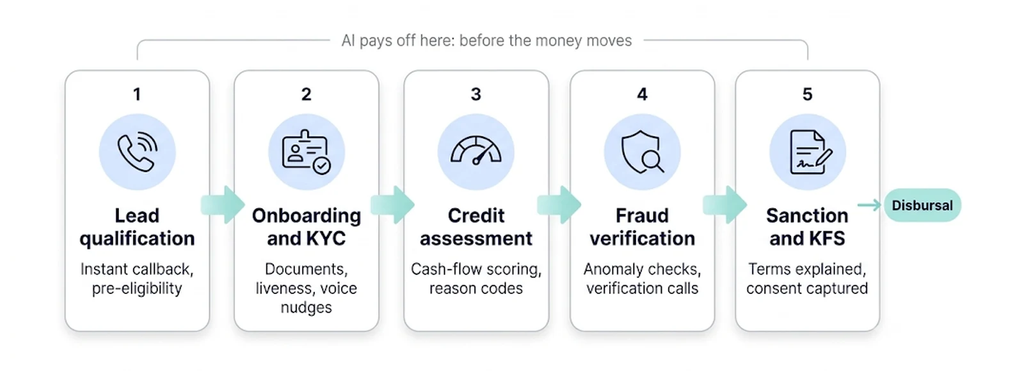
1. Lead Qualification and Pre-Eligibility
Inquiries go cold within hours. A voice agent can call each new lead within minutes, confirm the product, and capture age, occupation, and income for a soft pre-eligibility check. Strong leads route to the right channel, and weak ones get a clear next step instead of silence. This is the core of voice AI for lead generation, and conversational AI lead scoring adds a live intent score so the strongest applicants reach a loan officer first.
Outbound pre-eligibility calls run on the same rails as AI telemarketing, so set DND preferences and calling-hour limits before the first dial.
2. Onboarding and AI-Powered KYC for Lending
Most digital applications stall at KYC and document upload. AI-powered KYC for lending reads and validates PAN, Aadhaar-based eKYC, and bank statements, runs face match and liveness checks, and flags mismatches before an underwriter sees the file. Voice AI for loan onboarding handles the human side: it calls applicants who dropped off, explains what is missing in Hindi, Tamil, or Hinglish, and sends the right link while the borrower is still on the line.
Language is the hidden driver of drop-off here, which is why multilingual voice AI in India matters as much as the KYC stack itself. RBI permits only one-time access to the camera, microphone, or location for onboarding and KYC, with explicit consent, and bars storing biometric data unless the law allows it.
3. AI Credit Scoring and Underwriting
This is where AI in lending most directly shapes portfolio quality. AI credit scoring adds cash-flow signals to bureau data: bank statements shared through Account Aggregator, GST filings for small businesses, and salary credit patterns. This is how lenders assess thin-file and new-to-credit borrowers without lowering standards. AI loan underwriting then applies the lender’s policy to each file, drafts a recommendation with reason codes, and sends exceptions to a credit officer.
Explainability is not optional. Every automated decline needs a reason a borrower and an auditor can understand, and model drift needs regular checks against actual repayment.
4. Fraud Detection and Verification Calls
AI in credit risk assessment does its most valuable work at this stage. Models flag tampered PDFs, income that does not match bank credits, devices linked to many applications, and identity details that conflict across sources. A short verification call then confirms employment, address, loan purpose, and that the applicant actually requested the loan. Voice agents run these calls at scale and escalate any answer that conflicts with the file.
5. Sanction, KFS Explanation, and Disbursal Readiness
Borrowers who don’t understand their APR, fees, or cooling-off rights file complaints later, and AI in lending helps prevent that. Before disbursal, a voice agent can walk the borrower through the Key Fact Statement in their language, confirm understanding, answer questions, and set up e-sign and e-mandate. The lender gets a recorded confirmation, and the borrower enters repayment knowing the terms. The same approach carries into servicing, where conversational AI in Indian banking handles routine borrower requests once the loan is live.
Pre-Disbursal Scorecard for AI in Lending
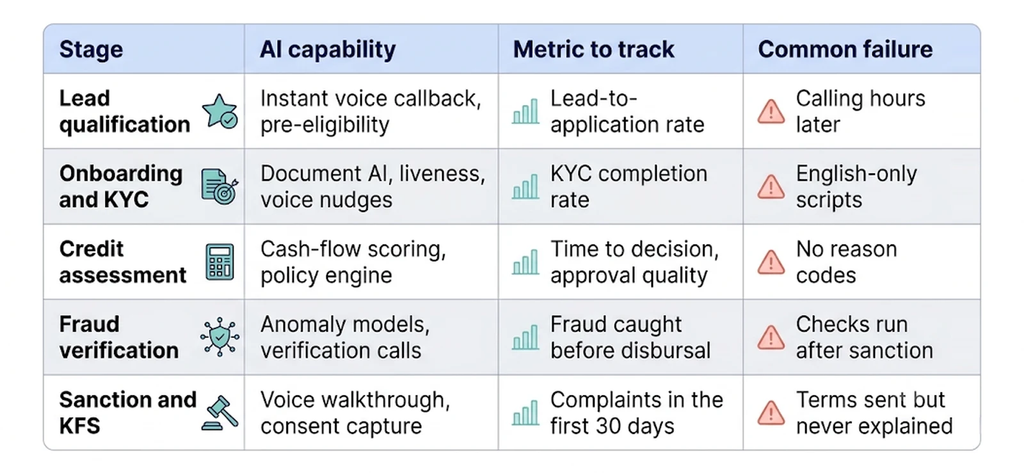
In short: track one metric per pre-disbursal stage, from lead-to-application rate to complaints in the first 30 days, and watch for the common failure at each step.
Compliance Guardrails for AI in Digital Lending in India
Most global guides on this topic lean on US and EU rules. Indian lenders answer to a different stack, and AI in digital lending has to be designed around it.
- RBI Digital Lending Directions: Data collection must be need-based, with prior and explicit consent and an audit trail. Borrower data must be stored on servers in India, and the lender remains fully responsible for any lending service provider it uses.
- RBI FREE-AI framework: The RBI FREE-AI committee report sets out 7 Sutras and 26 recommendations under six pillars for responsible AI in finance. Its message for lenders is clear: the institution stays accountable for AI-driven outcomes.
- DPDP Act and Rules: The lender is the data fiduciary, and most of its duties under the DPDP Rules become enforceable on 13 May 2027. Processing needs consent or a recognized legitimate use, so voice AI compliance in India starts with recording that basis on every borrower call.
- TRAI calling rules: Promotional loan calls must follow calling-hour limits and DND preferences and use 140-series numbers. Service and transactional calls, such as KYC follow-ups, use 1600-series numbers.
How to Implement AI in Lending Before Disbursal
- Map your funnel and find the two stages with the highest drop-off or manual effort.
- Pick one product, such as personal loans or two-wheeler loans, and one stage to start.
- Set baseline metrics: application completion, KYC completion, time to decision, and first-EMI bounce rate.
- Confirm consent flows, data residency, and calling-number setup with compliance before any pilot.
- Deploy a voice agent on stalled applications and KYC follow-ups in the borrower’s language.
- Add cash-flow scoring and policy automation for standard cases, with credit officers reviewing exceptions.
- Compare pilot cohorts against control groups on conversion and early delinquency, not conversion alone.
- Document model reasons, human overrides, and AI incidents so audits and FREE-AI reviews are simple.
Step 7 matters most. A pilot that lifts conversion but raises first-EMI bounces has moved risk forward rather than removed it. Once one stage proves out on both measures, use it as a template to scale AI in lending to other products.
Where AI in Lending Is Heading: Decisions Made in the Conversation
- Agentic orchestration: Instead of one model per step, agentic voice AI coordinates KYC, scoring, and verification in parallel while the borrower is still on the call.
- Real-time decisions on voice: With response times under a second, a voice agent can collect missing data, trigger a fresh score, and share a provisional answer within one conversation. Speed is a credibility issue: a borrower who hears long pauses on a loan call is quick to hang up.
- Vernacular by default: Lenders growing outside metros will run onboarding in the borrower’s language first, with English as one option among many.
For people, the shift is about focus. Credit officers focus on exceptions and policy, and relationship managers handle complex cases. Collections teams inherit cleaner books, which makes the work of AI voice agents for loan collections lighter after disbursal.
The Ello Advantage: Voice AI That Moves Borrowers to Sanction
Ello’s voice AI for financial services is built for the stages of AI in lending where conversations decide the outcome, from KYC walkthroughs to fraud-flag calls. It powers more than 50,000 calls a day, and its agents act on what borrowers say while the call is still live.
- Voice-to-Action Engine: Updates your CRM or loan workflow, sends KYC and e-sign links, and books follow-ups during the call through 40+ integrations, REST APIs, and webhooks.
- Adaptive Prompting Engine: Holds natural, non-scripted conversations, handles interruptions, and reads hesitation or urgency, so a KFS explanation slows down when the borrower needs it to.
- Multilingual Vernacular Native: Native support for 100+ languages with accent adaptation, including the Hindi-English code-switching common on Indian lending calls.
- Self-Evolving Architecture: Studies call outcomes and rewrites its own prompts, with guardrails, compliance checks, and audit trails on every change.
- Multi-Agent Quality Control: Specialized AI agents audit and improve each other’s performance across every call.
- Speed and Reliability: Sub-500ms response latency and a 99.99% uptime SLA.
- Enterprise Security Standards: SOC 2 Type II attested, with encryption, hallucination guardrails, and automated checks for TRAI DND registrations and calling-hour rules that help enterprises meet their regulatory duties.
Vendors differ most on latency, language coverage, and integrations, so test all three when choosing an AI voice agent platform.
See how it handles a live onboarding call in English, Hindi, and regional languages: Book an Ello voice AI demo.
Frequently Asked Questions
1) What is AI in lending?
AI in lending uses machine learning, language models, and voice agents across the loan lifecycle. Artificial Intelligence in loan assessment includes AI credit scoring, AI loan underwriting, and AI in credit risk assessment, helping lenders decide faster and more consistently while keeping human review for exceptions.
2) Where does AI in lending deliver the highest ROI?
AI in lending delivers its highest ROI before disbursal. Lead qualification, KYC completion, credit assessment, fraud verification, and term disclosure drive conversion, risk, and complaints. After disbursal, AI mainly manages a book whose quality was set at sanction.
3) How does AI credit scoring work for thin-file borrowers in India?
AI credit scoring adds cash-flow data to bureau scores, such as bank statements shared through Account Aggregator, GST filings, and salary credit patterns. This lets lenders assess new-to-credit borrowers on actual income behavior, with reason codes explaining each decision.
4) Is voice AI for loan onboarding compliant with RBI digital lending rules?
It can be, if the lender designs it that way. Voice AI for loan onboarding must collect data with explicit consent and an audit trail, store borrower data in India, follow TRAI calling rules, and explain the Key Fact Statement accurately. The lender remains accountable throughout.
5) Can AI-powered KYC for lending replace manual verification?
AI-powered KYC for lending can handle most standard cases: document reading, face match, liveness checks, and data validation. Manual review remains necessary for mismatches, suspected fraud, and edge cases, so the best setups route only exceptions to people.
6) What is the difference between AI in lending and traditional lending?
Traditional lending relies on manual document checks, bureau scores, and branch or call-center follow-ups, so decisions take days and thin-file borrowers are often declined. AI in lending automates KYC, scores cash-flow data, and follows up with borrowers by voice in their own language, so standard cases are decided in minutes, and people review the exceptions.
Conclusion
The most valuable work AI in lending does happens before a single rupee is disbursed. Lenders that put AI into lead qualification, KYC, credit assessment, verification, and disclosure will convert more of the demand they already pay for, block fraud earlier, and build the compliance record regulators expect. The next advantage belongs to lenders whose borrowers can complete that entire journey in one clear conversation, in their own language.